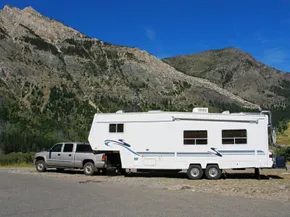
Tell me the truth. Draw calculations are boring. GVWR, GCWR, payload limitations and tongue weight must be considered. It can get confusing quickly. Does this rating include a full tank of gas? What about the dogs? cooler? tent? Can the sedan fit more equipment if you remove the trailer? The numbers are starting to add up. If you ignore these, you could burn out your axle or lose control on the highway.
But all this is not a mystery. Some numbers are very simple.
Consider gross trailer weight (GTW).
This is not a manufacturer’s estimate. This is not a theoretical limit. This is the actual physical weight of the trailer. Fully loaded. That figure includes every screw, every tire, every gallon of propane, every ounce of cargo.
“Gross trailer weight is the actual weight of all snowmobiles, firewood, camping gear, people or other cargo loaded on the trailer.”
This is the starting point. All other calculations (weight of drawbar, capacity of tow truck) start here. If you don’t know your GTW, you’re blind.
Why you need to know the actual weight of your trailer
Most people would guess. They see the sticker on the door and think that’s the limit. This is wrong. This label indicates the maximum weight that the manufacturer says the trailer can “handle”. You don’t know how much your trailer currently weighs.
GTW changes every time you pack.
- Do you want to add 4 people? Add about 700 pounds.
- Fill your clean water tank? Add about 8.3 pounds per gallon.
- Are you filling your closet? Add another 100-200 pounds.
The difference between an empty trailer and a loaded trailer is huge. Towing an empty trailer is easy. Towing a fully loaded vehicle over a mountain pass at 65 mph will tell you if the brakes and suspension are up to the task.
Where can I find the total weight of the trailer?
This cannot be accurately assessed. You have to weigh it.
- Public scale : Many truck stops, waste management facilities and landfills have a municipal scale. Search for “truck scale” or “weigh station”.
- Ask ahead : Not all public scales allow trailers. In some cases, only the weight of the truck is measured. Call first. Ask if you need to weigh the “trailer only” or the rig.
- Steps : Drive to scale. Make sure the trailer is disconnected from the towing vehicle. Close all doors, hatches and windows. Roll up all windows. This will give you an idea of the actual weight of your device while driving.
How to use GTW for towing installations
When you get the number, you’re not done yet. This figure feeds into your tow vehicle’s limits.
Tractor units have a gross combined weight rating (GCWR). This is the maximum vehicle weight + trailer. If your GCWR is 20,000 pounds and your loaded trailer (GTW) is 8,000 pounds, you have an additional limit of 12,000 pounds for your truck.
But wait.

Where is the trailer’s gross rating?
You don’t need a degree in physics to calculate the gross trailer weight (GTW). Forget about complicated math and percentage calculations. The easiest way is to catch up. Place the device on the scale. The real challenge isn’t the math. I was looking for something big enough to swallow the entire trailer.
Most cities have a public scale. They are often hidden near highways or industrial areas. Get the information you need for just a few dollars and five minutes of your time. But accuracy is important. One small mistake can ruin your entire towing setup.
Scaling: Avoid language pitfalls
Once it is on the scale, detach the trailer from the tow truck. This is not negotiable. We measure each trailer individually. Pull the truck far enough forward so that the rear bumper or hitch does not touch the leveler. If the scale has a metal connection, the reading is incorrect.
Make sure each wheel is on the ground and completely within the limits of the scale. This includes trailer tongue. Yes, this is the part that has to do with the ball. If your tongue is hanging off the edge, you are making a big mistake. Resting the tongue will cause your weight reading to be 9-15% less than your actual GTW. This is a dangerous margin of error when driving on the highway.
Empty or full: which is heavier?
There are two options here. Drive in a loaded or empty trailer.
Load it, weigh it, and you’ll know exactly what you’re carrying. This is the most accurate snapshot of your current setup. There are no guessing games.
If you weigh an empty trailer, record its baseline. Now you know where to start. Do you want to add a product? You can estimate the total weight by adding together the approximate mass of the cargo and the empty tare weight. This is a close enough estimate for most trips. Write down the log. It worked.
Find size and manufacturer information
Where can I find these scales? Check the local directory. Or search online. Find a bus scale near you. They spent a few dollars. This information is much more valuable. A broken axle or camber accident can cost you well over $5.
There is another method. Contact the trailer manufacturer directly. They have specifications. Contact us regarding dry weight and load capacity. Download this information securely from day one. This is a good secondary check for scaling.
Weight distribution is more than just a number on a screen. It’s about the physics of keeping the tires on the asphalt.