Temptation is a constant presence. You see a donut. You eat it. You get sick. You could also skip work to gamble, but explaining your sudden wealth to your boss is a nightmare.
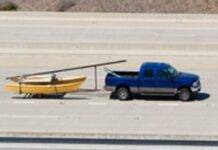
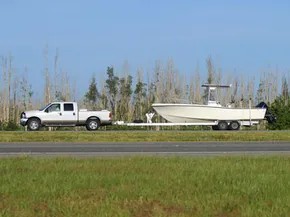
The same logic applies to towing. You bought a boat. You didn’t check your truck’s limits in the owner’s manual. Now, with the hitch ball inches from the coupler, you’re itching to hit the lake.
Stop.
Ignoring your vehicle’s towing capacity isn’t just bad advice. It’s dangerous.
Consider a scenario where a pedestrian steps into the road. Your truck is overloaded. The rear-heavy trailer creates massive momentum. Your brakes can’t stop that weight. You plow into the person. The force might even break the hitch coupling, sending the boat flying into your cab.
Even if you survive the drive, the launch ramp is a trap. Backing down the incline with too much weight can lift your truck’s front wheels off the ground. You’ll end up in the water with a dead engine.
There are also mechanical failures looming. Exceeding limits wears out your drivetrain, suspension, and brakes rapidly.
Here is exactly what happens when you ignore those specs.
Mechanical Breakdowns from Overloading
Your vehicle is engineered for specific loads. The manufacturer calculates towing capacity based on the chassis strength, engine torque, transmission cooling, and braking systems. When you exceed this limit, you force components to work beyond their design parameters.
The suspension bears the brunt of this abuse. Leaf springs or coil springs compress beyond their elastic limit. This causes premature fatigue. You might experience sagging rear ends, which alters your headlight aim and handling dynamics.
The transmission takes a severe hit. Towing heavy loads generates immense heat. If your vehicle lacks a dedicated transmission cooler, the fluid breaks down. Overheated transmission fluid loses its lubricating properties. This leads to slippage. Slippage causes friction. Friction destroys clutches and bands inside the gearbox.
The engine isn’t spared. Towing uphill at high loads pushes the engine into high RPM ranges for extended periods. This increases internal temperatures and wear on piston rings and bearings. You’re essentially redlining your engine’s lifespan daily.
Brakes are the most critical safety component. They must dissipate the kinetic energy of both your truck and the trailer. An overloaded trailer adds mass that your brake pads and rotors cannot safely manage. This leads to brake fade. Fade occurs when overheated brakes lose friction. You press the pedal, and nothing happens.
Safety Risks of Exceeding Towing Limits
Beyond mechanical failure, there are immediate safety hazards. Handling changes drastically. The rear of your vehicle dips. The front lifts. This reduces steering control.
You might experience trailer sway. This happens when the trailer’s center of gravity is too high or the load is uneven. At highway speeds, sway can become violent. It can detach the trailer from the hitch entirely.
Visibility is compromised. A heavy trailer might block your rearview mirror. You can’t see traffic behind you. This makes lane changes and emergency stops risky.
Fuel efficiency plummets. Drag increases with weight. You’ll burn significantly more fuel. This isn’t just bad for your wallet. It’s bad for the environment.
Legal consequences are another factor. If you cause an accident while exceeding your **towing capacity
Swaying is the silent killer on the highway. You might think your truck can handle a little extra weight, but exceeding your vehicle’s towing capacity doesn’t just mean you’re dragging through mud or slipping into a lake because your brakes failed. It means your trailer starts dancing on its own. The load moves side to side, independent of where your steering wheel is pointing. This is dangerous. It happens even when you’re technically within limits if the setup is wrong. But if you push past the red line? The physics get nasty fast.
You might get lucky. You might make it from point A to point B a dozen times without a hitch. Eventually, though, hubris catches up. The mechanical debt comes due.
The Transmission Meltdown
Your truck’s transmission is a precision instrument. It’s built to move the vehicle plus a specific amount of additional weight. That number isn’t a suggestion. It’s a hard limit set by engineers who did the math.
When you exceed that towing capacity, you are asking the transmission to do work it was never designed to sustain. The gears grind. The torque converters slip. Heat is generated. A lot of it.
This heat is the enemy. It breaks down the transmission fluid. That fluid isn’t just a liquid; it’s your lifeline. It lubricates the moving parts and keeps temperatures down. Once the fluid degrades, lubrication fails. The metal parts contact each other directly. Friction spikes. The transmission seizes. Major damage follows. You’re looking at a tow to the shop, not a smooth ride home.
Hitches and Heat Management
People often think buying a fancy trailer hitch fixes their weight problems. It doesn’t. Upgrading your hitch only increases the hitch’s rating. It does nothing for your vehicle’s drivetrain. You still have to deal with the same physics.
However, there is hardware that helps manage the load. A weight-distributing hitch shifts the burden. It spreads the tongue weight across the coach vehicle’s axles and the trailer’s axles. This stabilizes the rig and reduces the strain on your suspension and drivetrain. Just remember: you still have a weight distributed tow rating. Don’t exceed that either. The same mechanical failures await you if you ignore the specs.
The real shield against the heat? A transmission oil cooler.
Factory coolers are often adequate for light duty. They are not adequate for heavy loads. Installing an aftermarket transmission oil cooler in front of your radiator gives the system a boost. The fluid runs through this extra cooler before hitting the transmission. It drops the temperature significantly. You protect the internal components from the thermal abuse that leads to seizure.
Weighing Your Trailer
The easiest way to avoid all of this? Don’t overload.
You need to know your gross trailer weight. This isn’t a guess. You can’t eyeball a loaded camper and get it right. You need a scale.
Leave the bathroom scale out of this. It will break. Your cat will break it. You will break it.
Search for public or private scale locations near you. Truck stops, construction sites, and some weigh stations offer this service. Get a precise number. Compare it to your owner’s manual. If the number is lower, you’re good. If it’s higher, you’re risking your transmission.
Don’t exceed the limit. Tow to your heart’s content, but respect the numbers. They exist for a reason.
Related Articles and Resources
- How Tow Dollies Work
- How Camper Towing Works
- Is there a green way to tow?
- What are my car towing options?
- 10 Towing Tips
More Great Links
- Safety Towing Tips and Terminology
- Towing.com
- Trailer Life Magazine
Sources
- “Determining registered gross weights for trucks towing recreational and light duty trailers.” Ontario Ministry of Transportation. July 27, 2007.
- “Frequently asked questions.” Fluid Drive.
- “Safety towing tips and terminology.” Davis Trailer World.
- “What an oil cooler does.” Perma Cool.