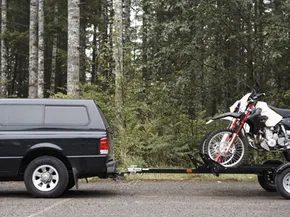
Forget everything you learned towing a sedan or a boat. Towing a motorcycle is a different beast entirely. The experts don’t mince words on this one: it stands in its own category. It isn’t just about hooking up a hitch. It’s about technique. It’s about safety. It’s about not ending up on the side of the highway with a twisted frame and a bruised ego.
You need to understand the mechanics before you even think about hitting the interstate. Practice in a safe, empty lot first. Feel the weight. Learn the braking distance. You’ll need to master loading procedures to ensure the load is balanced correctly. The golden rule? Sixty percent of the weight must sit in front of the trailer’s axle. Forty percent behind. Get this wrong, and your trailer will sway like a drunk sailor. You’ll also need to adjust your driving habits. Wide right turns are non-negotiable. Cut corners, and you’ll clip the curb or, worse, another vehicle.
The Two-Wheel Problem
Motorcycles don’t sit four wheels down on the pavement. They stand on two. This makes tipping a genuine threat. Stability is an illusion on two wheels. Securing the bike is harder, too. Most cars come with factory-installed cargo slots. They’re designed to keep things from sliding around. Motorcycles and ATVs rarely have this luxury.
Instead, you’re lashing the saddle. You’re routing straps through the handlebars. It’s a procedure that varies from bike to bike. A dirt bike rigs differently than a touring cruiser. You need to practice this. Do it in your driveway. Do it until it’s muscle memory. If the bike shifts during transport, you’re playing Russian roulette with your cargo.
Legal Landmines and Insurance Gaps
Before you tow, look deeper. State laws vary wildly. Some states have strict height restrictions. Others mandate specific lighting for trailers. You need to know what applies to you. Insurance is another trap. Your standard auto policy might not cover the motorcycle while it’s in tow. You need to verify your coverage. Don’t assume you’re protected.
This article dives into both the legal and logistical sides of towing a motorcycle or ATV. We’re going to break down the state-by-state regulations. We’ll look at the specific requirements that could land you in hot water. On the next page, we examine the towing laws by state.
Motorcycle and ATV Towing Laws by State
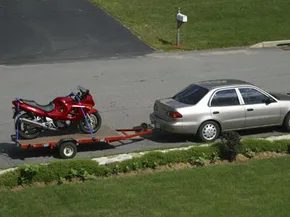
Forget the idea that a trailer is just a trailer. When you’re hauling an ATV or motorcycle across state lines, the legal landscape shifts under your tires. It’s not enough to know your local rules. You need to navigate a patchwork of regulations that change with every border you cross.
Most states agree on one thing: safety chains. You’ll find explicit requirements for them in 46 states. These aren’t just suggestions. They’re the mechanical lifeline that keeps your trailer from detaching and becoming a road hazard if the hitch fails. Four states don’t explicitly list this requirement in their statutes. Maybe they assume common sense. Maybe they don’t. The risk isn’t worth the ambiguity. Always rig them up.
Then there is the vertical problem. Height limits.
Thirty-three states cap trailer heights at 13.5 feet. Sixteen allow up to 14 feet. But if you’re planning a trip through the Rockies or the Plains, pay attention. Colorado enforces a strict 13-foot limit. Nebraska goes the other way, permitting 14.5 feet. These aren’t minor variances. They are hard stops. Ignore them, and you won’t just get a ticket. You’ll get stuck. Literally. The rear of your rig will meet the underside of an overpass with significantly more force than you anticipated.
Width and length matter too. They vary wildly. One state might allow a wide load with a permit; another might treat it as a felony. Check the dimensions for every jurisdiction on your route. Don’t guess. Measure twice. Cross-reference with local DMV codes.
Visibility is another shared burden. Reflective plates on the rear and sides are mandatory in most jurisdictions. Brake lights, turn signals, and tail lights are non-negotiable elsewhere. You are responsible for their functionality. A burned-out bulb isn’t a mechanical oversight. It’s a citation waiting to happen. Fix them before you leave the driveway.
Reciprocity offers a shield, but it’s cracked in places.
Forty-seven states and all Canadian provinces practice reciprocity. This means if your setup is legal in your home state, you generally won’t be penalized for it in another. If you’re from Illinois towing an 8.5-foot-wide trailer through Arizona, where the limit is 8 feet, you’re usually in the clear. The law respects your home jurisdiction’s standards.
But reciprocity doesn’t apply everywhere. Colorado, Delaware, and Georgia do not play by these rules. They enforce their own standards strictly. Even if your setup is perfectly legal at home, you can still face fines in these three states. They prioritize local safety margins over interstate consistency. Don’t assume you’re safe because you’re licensed elsewhere.
Insurance is the final piece of the puzzle, and it’s where many owners get burned.
Motorcycle and ATV Towing Insurance

Why Standard Auto Policies Don’t Cover Your Tow Setup
You might think your current car insurance handles everything because the trailer is attached, but that is a dangerous assumption. Most standard auto policies explicitly stop at the hitch. They cover the tow vehicle, period. The trailer itself, and whatever you are hauling on it, falls into a coverage gap that can leave you financially exposed.
This is why having a separate policy for your trailer is not optional. It is essential. Even if your home state does not mandate trailer insurance, crossing state lines changes the rules instantly. You could drive through a jurisdiction with strict laws and get hit with a massive fine for non-compliance. The penalty doesn’t care where your license plate is registered. It only cares that you are uninsured in that moment.
The reality is that you are looking at three distinct insurance policies for a complete tow setup:
- One for the coach vehicle doing the pulling.
- One for the trailer structure itself.
- One for the cargo, whether that is a motorcycle or an ATV.
Each component has mass. Each component has momentum. Each has the potential to cause damage or injury. Treating them as a single insured unit is a mistake that leads to denied claims.
How Liability Works When Things Go Wrong
Imagine you are cruising down the highway. The trailer begins to sway. Maybe it was a gust of wind, maybe it was improper weight distribution. Suddenly, the trailer swings wide, clipping the side of an oncoming sedan. The impact jars the tie-downs. Your motorcycle slides off the ramp and tumbles onto the asphalt. Seconds later, a third vehicle plows into the fallen bike.
It sounds like a scene from a disaster movie. It is also exactly how accidents happen.
When this chain reaction occurs, the insurance fallout is complicated. You will likely face three separate claims:
- Collision coverage on your motorcycle policy covers the damage to your bike.
- The driver of the sedan hit by the trailer will file a liability claim against your trailer insurance.
- The driver who hit your motorcycle will file a liability claim against your motorcycle policy.
That sounds complete, right? It is not.
In most states, the driver of the tow vehicle is considered at fault for trailer accidents. If the trailer was swaying due to speed or improper loading by the driver, the tow vehicle’s insurance policy also comes into play. The other drivers may sue the driver of the coach vehicle. Without proper coverage on the towing rig, you are personally liable for damages that exceed your other policies.
Navigating State-Specific Towing Regulations
Towing laws are not uniform. They vary wildly depending on where you are. This is why checking local regulations before you start the engine is part of the insurance equation. Some states require specific braking systems on trailers. Others have strict width or lighting requirements. Failing to meet these mechanical standards can void your insurance coverage entirely.
If an accident occurs and your trailer is found to be non-compliant with state laws, insurers often deny claims based on negligence. You cannot argue that you “didn’t know” about the regulation. Ignorance of the law is not a defense when it comes to liability.
The Bottom Line for Towing Enthusiasts
You need to sit down with your insurance agent and map out a strategy. Do not assume your current bundle covers your rig. Ask specifically about:
- Trailer-specific liability coverage
- Cargo protection for high-value items like motorcycles
- Uninsured motorist coverage in case you are hit by someone else while towing
The cost of adding these riders is minimal compared to the cost of a single major accident. You are moving heavy metal at highway speeds. The margin for error is slim.
Proper insurance is just one part of the equation. You also need to understand weight distribution, brake controller settings, and tie-down techniques. But without the financial safety net, a technical error becomes a financial catastrophe.
Check your policy limits. Check your state’s towing laws. Then hit the road with confidence.