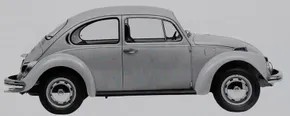
It was a perfect storm. The 1970-1972 Volkswagen Beetle struggled with rising costs, a design that felt as dated as last week’s bread, and competitors that looked and drove like the future. Adding more stringent safety and emissions legislation is a recipe for irrelevance.
Volkswagen of America tried to lighten the mood in 1971. In one ad, a beetle-shaped gimmick hovered over the text: “How long can we keep giving you this line?” There were two answers to the question. Not much to the west. Indefinitely, for the rest of the world.
The car survived in developing countries. It just stayed. It handled bad roads and harsh climates without complaint. That was the original spirit of the brand. But for North American and Western European buyers with money to spend, the Beetle became less attractive.
Why did the Volkswagen Beetle become more expensive between 1970 and 1972
Germany’s economy is booming, thanks in part to the car it built. A stronger German mark meant higher prices for American buyers. In 1966, the base price was a manageable $1,575. By 1970 it had risen to $1,874. By 1976 it would reach $3,500.
At the same time, the control authorities approached. The new regulations threatened to ban the air-cooled engine on both sides of the Atlantic. At the same time, the beetle’s unique status evaporated. Competitors copy VW’s solid structure and customer-friendly sales model. They no longer needed a dealer to get good service.
Most of the time the car was just old. Road & Track summed it up in 1971: If you valued fuel economy, craftsmanship and durability above all else, the Beetle was still an option. Otherwise it was hopelessly out of date. Japanese and American economy cars had already overtaken it.
What changed in the 1970 model year
Volkswagen did not stand still. They made changes to keep the car competitive at least for a while.
For the 1970 model year, the most significant improvement took place under the hood. Engine displacement increased to 1600 cc, matching the Type 3. Power increased to 57. It wasn’t a revolution, but it was something.
Other updates were minor but necessary for compliance and security reasons. The models have an ignition key warning buzzer. The front indicators grew. These were incremental fixes to a design that running on fumes.
“If you value [these] virtues above all else, then the Beetle is for you. Otherwise, it’s hopelessly out of date and outclassed by both Japanese and American economy cars.” — Road & Track, 1971
The clock was ticking. The Beetle still had plenty of life in places where roads were bumpy and budgets were tight. But in the West, the simple days were over. The car that conquered the world was now struggling just to stay relevant in the markets that built it.
引擎盖下和皮肤外
到 1971 年,风冷发动机的功率小幅提升至 60 马力 。 这不是一场性能革命,但它有所帮助。 大众汽车还再次加大了尾灯——因为显然,每年都需要这样做——并最终采用了流通式通风 。 旧车变得闷热; 这辆车可以呼吸。
但真正的新闻是1972 年大众超级甲壳虫 (在欧洲被称为 1302S)。 这不仅仅是徽章的改变。 它带来了带有螺旋弹簧的麦弗逊支柱前悬挂 ,取代了几十年来定义甲壳虫行驶风格的扭杆。 鼻子伸长了 3.2 英寸。 轴距增加了0.8英寸。 后备箱空间足足增加了 3 立方英尺。 是的,油箱也变大了:11.1 加仑 ,与旧款 10.6 加仑相比。 所有这些都导致转弯圈更紧。 它的操控方式完全就像一辆不同的汽车。
大众汽车当年还推出了一款精简版基本型轿车。 很便宜。 真的很便宜。 价格为 1,845 美元 ,是价格领先者。 你没有得到奢侈。 你有交通工具。 对于一些买家来说,这已经足够了。
“”Baja” Package and Sales Milestones
Sales were weak. Volkswagen needs a spark. So they did what all automakers do when they have problems. Special Edition has been released.
The 1972 “Baja” Kit was a $130 dealer-installed kit for the super sedan. This includes:
Side stripes
– Short-throw shifter
-Fog lamps
– Faux leather steering wheel cover
– Mag style wheel cover
– Walnut dash appliqué
– Tapered exhaust tips
It’s more about style than substance. But it worked. People bought the kits.
They like the look.
Further improvements were made to the 1972 lineup. The large rear window improves visibility.
The engine cover now has four cooling holes instead of two. The speedometer has been changed. The control lever has changed. A hinged parcel shelf appears behind the rear seats. small change. Cumulative effect.
Then came the big moment. At the beginning of 1972, Volkswagen Beetle total sales exceeded 15 million units. The Ford Model T held this crown for decades. Now the Beetle has got it. “The most popular car in the world”
The title is stuck. However, sales declined in the second half of the decade. Although the design is quite old. The numbers don’t lie. The Beetle had won.
Keep Your Eyes on the Bug
This concludes the deep dive. If you’re still looking for information on these German icons, there is more where that came from. Check out the Volkswagen Beetle page for history and specs you may have missed.
Want to see what they cost today? The New Volkswagen Prices and Reviews section lists the current offer without unnecessary details.
And when you’re looking at the secondary market, check out used Volkswagen prices and reviews. Real data. Actual values. No guessing.