“Cheap is small, and not too steep, but best of all, cheap is cheap.”
Ray Davies sang those lines for The Kinks in 1979. He probably didn’t have the Tara Tiny in mind. But Tara International’s chairman and CEO, Tara S. Ganguly, might agree with the sentiment, if not the cynicism. Ganguly views the Tiny not as a joke, but as a pragmatic answer to two urgent crises: depleting fossil fuels and rising pollution.
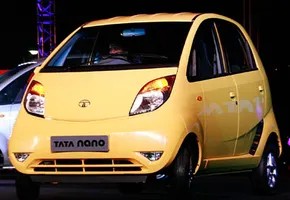
The result is a two-seater that costs roughly $2,400 (99,999 rupees). It is the world’s cheapest electric car, beating its nearest Indian rival—the Tata Nano—by a single rupee. While the Nano relies on a traditional combustion engine, the Tiny is purely battery-powered. It is an EV designed for the emerging market, where regulations are looser and costs are tighter.
You won’t see this on American roads. But for commuters in India, it offers a glimpse into a future where personal transport doesn’t require a mortgage.
More Have Nots Than Haves: Tara Tiny Specs
Ganguly stripped the vehicle down to its absolute essentials. If you want comfort, you pay extra. The base model is a lesson in minimalist engineering.
Here is exactly what you get for your $2,400:
- Maximum Speed: 25 mph (40 km/h)
- Motor Power: 1.5 kilowatts (~2 horsepower)
- Battery: Sealed lead-acid, 200 amp/hours capacity
- Charging: 8 hours at home on a standard 220-volt, 15-amp outlet
- Range: Approximately 50 miles (80 km), depending on conditions
- Transmission: Three-speed automatic
- Brakes: Front disc, rear drum
- Features: Manual driver seat adjustment, driver-side mirror, fog lamps, windshield wipers
That is it. No power steering. No air conditioning. No sound system. Just the basics to get from point A to point B without burning gas.
Ganguly’s vision remains intact. The company plans variations with four doors, four seats, AC, power steering, and windows. But the core philosophy stays the same: amenities are extras, not entitlements.
Fewer Regulations = Less Cost
Why is this car so cheap? The answer lies in geography and policy. Industrialized nations in Europe and North America enforce strict emissions and safety standards. Compliance can add $5,000 to $10,000 to a car’s price tag. Add the R&D costs for alternative fuel technology, and a viable green vehicle could easily cost $20,000 more than its fossil-fuel counterpart.
Emerging markets like India and China operate differently. They have a long history of transportation innovation. Now, as their domestic tech bases mature, engineers are building green vehicles that bypass the heavy regulatory burdens of the West.
The Tara Tiny is one such example. Another is the Kanso, developed by Indian designer Kanak Gogoi. The Kanso is a two-seat hybrid that runs on gasoline and solar energy from four roof panels. It generates 320 watts from the sun. It lacks a traditional transmission. It features a tiny 0.1-liter engine. Its top speed is around 30 mph. It is projected to sell for roughly $3,800.
How the Kanso blends two energy sources remains unclear. But like the Tara Tiny, it proves that low-cost alternative fuel vehicles are not just theoretical concepts. They are already on the drawing board in developing economies.
“Savvy car companies and engineers are producing a variety of green vehicles… One prime example is the Kanso.”
The Tara Tiny challenges the notion that electric vehicles must be luxury items. It forces us to ask: What do we actually need a car to do? For many in India, the answer is simple transportation. Not status. Not speed. Just movement.
The technology exists. The price is right. The only question is whether the infrastructure can keep up.
Urban Agility Over Highway Dominance
Tara International’s CEO, Tara Ganguly, isn’t hiding behind the vehicle’s modest 25 mph (40 km/h) top speed. That limit isn’t a engineering failure; it’s a design constraint for a specific use case. The Tara Tiny was built for dense urban corridors, not the chaotic, high-speed highways of India. Trying to take this thing on a road trip is a bad idea. But for short, stop-and-go city commutes, an electric vehicle offers structural benefits that internal combustion engines simply can’t match.
The core difference lies in mechanical complexity. A standard gasoline car the size of the Tiny contains over 2,500 moving parts. The Tara Tiny has roughly 35.
This reduction in part count drives three immediate advantages:
- Reliability: Fewer parts mean fewer things that can break, wear out, or need replacing. The maintenance burden drops significantly.
- Safety and Cleanliness: Zero tailpipe emissions are a given. Furthermore, crash physics change at 25 mph. Most fatal accidents involve speeds exceeding this threshold. Keeping the vehicle within this band inherently reduces risk.
- Operating Economics: When you factor in fuel, maintenance, and repairs, electric vehicles typically cost just 10 to 15 percent of a comparable gas car to run. Ganguly estimates operating the Tiny costs mere pennies per mile over its 25-year lifespan.
But the real story here is efficiency. To understand why, you have to look under the hood of the drivetrain.
Why Electric Motors Win on Efficiency
Beyond the bicycle, the electric motor is the most efficient mechanical device for converting energy into motion, boasting an efficiency rating above 90 percent. What does that number actually mean? It means that 90 percent of the energy drawn from the battery goes directly into moving the car. Only about 10 percent is lost as waste heat or friction.
Compare that to the best internal combustion engines, which hover around a 20 percent efficiency rating. In a gas car, roughly 80 percent of the energy in the gasoline is burned up just to get power to the wheels. The rest is lost as heat, noise, and internal friction.
This disparity explains a common driving habit: cars get better mileage on the highway than in the city. Once a gas car is moving, it takes less energy to keep it rolling. The engine hates idling, but it hates acceleration even more. This is where an electric motor changes the game.
Ganguly, an engineer by trade, understands the mechanical drag of traditional drivetrains. In a gas engine, cranks, gears, differentials, and drivelines all have inertia. They need time and energy to get moving before that rotary force finally reaches the wheels. Plus, there’s the issue of “idle time.” When you stop at a red light, the engine keeps burning fuel, creating motion that goes nowhere, just in case you need to accelerate in a few seconds.
The electric motor sidesteps both issues.
- Instant Torque: An electric motor delivers maximum torque almost immediately. If linked directly to the wheels, that energy is available the moment you press the pedal. No clutch engagement delay. No gear shifting lag.
- Zero Idle Loss: When the car stops, the motor stops. It doesn’t waste energy spinning internally. It shuts off, conserving battery life until the next burst of movement is required.
The Tara Tiny relies on sealed lead-acid batteries, an electronic controller similar to a throttle, a converter, and those efficient electric motors. There is no complex transmission to lose power in.
The Road Ahead
Tara International hasn’t released specific launch dates for other models in their lineup. However, the Tiny’s philosophy—stripping away complexity to maximize urban efficiency—might set the benchmark for future electric vehicle adoption in emerging markets. It proves that you don’t need a 150-mph hypercar to solve urban mobility; you just need something simple, cheap to run, and safe.
For those looking to dive deeper into the mechanics of electrification and alternative energy, the following resources provide broader context.
Related Articles:
* How Alternative Fuel Filling Stations Work
* How the Hybrid Tax Credit Works
* How SmartWay Vehicles Work
* How the Toyota A-BAT Hybrid Truck Works
* How the Ford Fusion Works
* How the Toyota Prius Works
* How the Venturi Astrolab Works
Sources:
* Edmunds.com. “Car Cost Comparison.” (Accessed May 5, 2009)
* EarlyElectric.com. “Electric Car History.” (Accessed May 12, 2009)
* Hatch, Steve V. Computerized Engine Controls. Eighth Edition, 2009, Delmar Cengage Learning.
* Khaund, Surajit. “State Innovator Develops New Hybrid Car.” The Assam Tribune. January 8, 2008.
* Tara International. “Battery Operated Four Wheelers.”
* Tara International. “Profile.”