


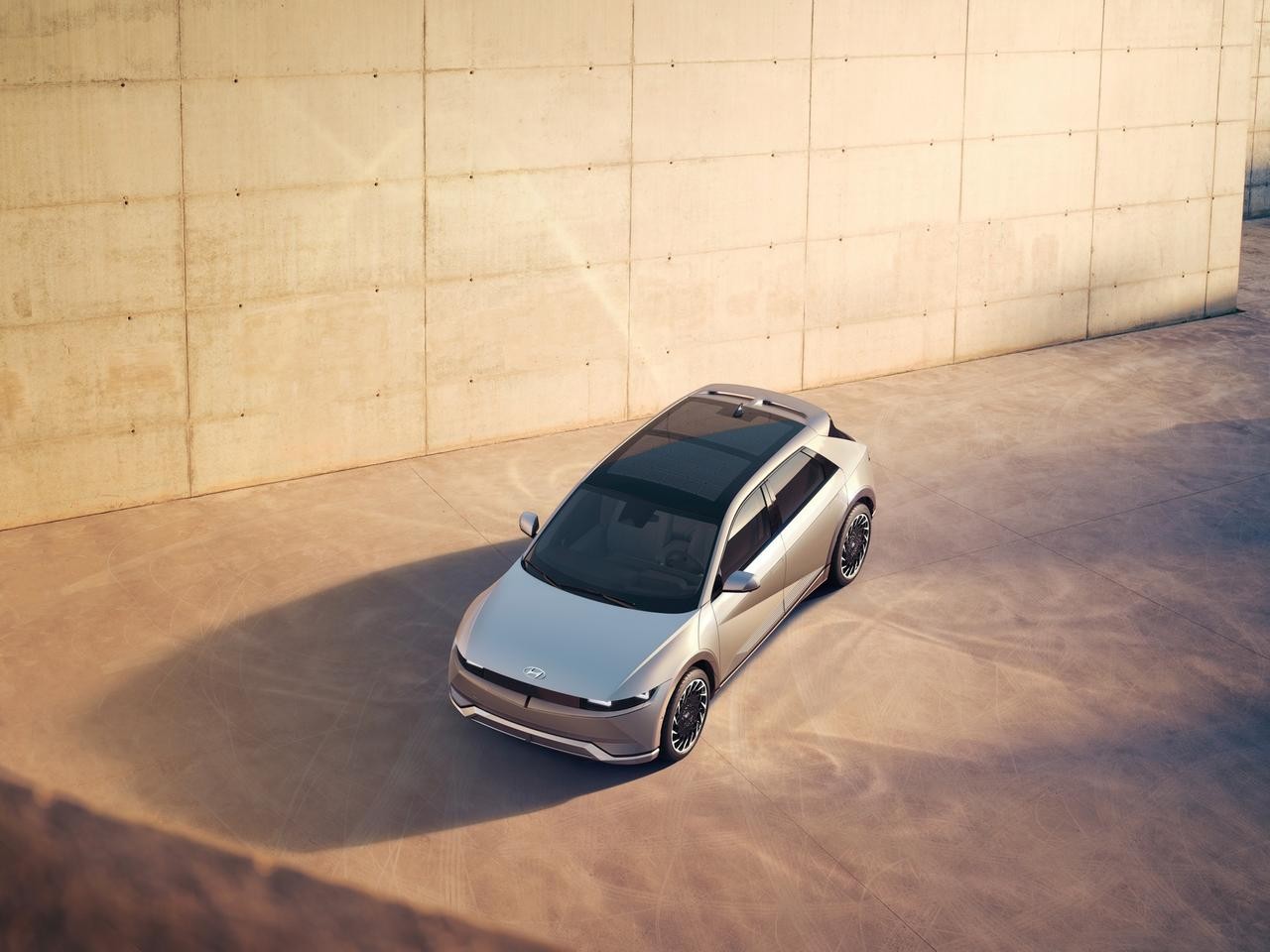
Hyundai didn’t just tweak a logo. They spun Ioniq off into its own standalone brand and immediately dropped the Ioniq 5. This compact SUV is the opening act in a three-car lineup designed to shake up the electric vehicle market. The roadmap is aggressive. By 2022, expect the Ioniq 6 sedan, derived from the EV Prophecy concept shown in March. Then, early in 2024, the Ioniq 7 arrives as a larger SUV boasting what Hyundai calls “aerodynamic silhouettes with perfect proportions.”
But let’s focus on what’s here now. The Ioniq 5 draws heavy inspiration from the 45 concept car debuted at the 2019 Frankfurt Motor Show. That concept was a love letter to the Hyundai Pony, celebrating its 45th anniversary. Hyundai kept the production model’s front end straight from that concept. You get the square LED headlights. You get the razor-sharp, geometric lines that echo the 1970s Pony. The silhouette is clean. Minimalist.
It’s not just a pretty face, though. The production Ioniq 5 is significantly chunkier and more athletic than its concept ancestor. The real magic happens underneath the sheet metal. The wheelbase stretches to three meters. That extra length doesn’t just make the car look planted. It creates a cavernous interior that defies the compact SUV classification.
The cabin vibe inside the Hyundai Ioniq 5 is exactly what you’d expect from a brand doubling down on minimalism. It’s quiet. Calm. The light colors do the heavy lifting here, making the space feel significantly larger than it actually is. You don’t get that cramped EV anxiety. Instead, you get this airy, sun-drenched box that feels more like a living room than a cockpit.
The digital dashboard setup
Front and center, you’re staring down two massive 12-inch displays. One handles the driver info. The other controls everything else—navigation, media, the whole shebang. They sit side-by-side, creating a continuous wall of glass. It’s clean. Maybe too clean if you’re used to tactile feedback.
Thankfully, Hyundai didn’t go full Apple CarPlay-and-pray. You still get physical buttons. Specifically for climate control. Heating and cooling don’t require digging through sub-menus on a touchscreen. That’s a win for usability. You can adjust the temperature without taking your eyes off the road for long.
Practicality in a stylish package
Looks are important, sure. But the Ioniq 5 also plays the practical card hard. Under the rear hatch, you’re looking at a cargo area that maxes out at 531 liters. That’s not just adequate; it’s competitive with many compact SUVs. You can fit grocery runs, gym gear, or a week’s worth of camping stuff without folding seats.
And if you need to haul more than groceries? The Ioniq 5 is rated to tow up to 1.6 tonnes. That opens up possibilities. Small trailers. Jet skis. A tandem bike rack. It’s a lifestyle car, not just a tech demo.
The Ioniq 5 proves that futuristic design doesn’t have to sacrifice everyday utility.
The combination of light interiors, dual screens, and genuine towing capacity makes this a compelling option for those looking for an electric vehicle that works as hard as it looks.
Breaking down the e-GMP powertrain options
The Ioniq 5 rides on Hyundai and Kia’s shared e-GMP platform, offering a clear split between rear-wheel drive and all-wheel drive configurations. If you opt for the standard rear-wheel drive setup, there are two distinct paths. The entry-level model pairs a 125 kW motor—delivering 350 Nm of torque—with a smaller 58 kWh battery pack. Step up, and you get a 160 kW motor backed by the larger 72.6 kWh battery.
All-wheel drive changes the math significantly. You have two dual-motor combinations to choose from. The 58 kWh version uses a weaker front motor (53 kW) paired with a 120 kW rear unit. The more powerful 72.6 kWh variant steps things up with a 70 kW front motor and a robust 155 kW rear motor.
For those prioritizing range, the WLTP cycle puts the maximum autonomy at 480 km. This top-tier range is exclusive to the 72.6 kWh models in rear-wheel drive.
Hyundai ne joue pas aux apprentis sorciers avec l’architecture électrique de ce bolide. Le Ioniq 5 accepte les batteries 400 volts comme 800 volts, ce qui lui permet d’encaisser une charge de pointe jusqu’à 220 kW. C’est de la vraie puissance. Dans les scénarios les plus favorables, une pause de cinq minutes suffit à récupérer 100 km d’autonomie. C’est rapide. Très rapide.
L’engin dispose aussi d’une fonctionnalité pratique souvent absente chez les concurrents : la charge bidirectionnelle ou V2L. Le terme barbare signifie simplement que la voiture peut devenir une prise géante. Vous avez accès à 3,6 kW pour alimenter du matériel. Idéal pour le camping. Ou pour recharger un vélo électrique en pleine sortie. Une trottinette aussi. L’équipementier ne s’arrête pas là.
Les premiers modèles arriveront chez les concessionnaires dès juin. La barre des prix est fixée à 41 900 euros pour l’entrée de gamme. Une entrée en lice agressive. Surtout si l’on considère ce que promet la technologie sous le capot.
Recharger son équipement n’est plus un frein
La présence du V2L change la donne pour les utilisateurs nomades. Plus besoin de chercher une prise 220V classique pour brancher son appareil. La voiture devient le générateur. C’est pratique. C’est simple. Et ça répond à un besoin concret pour ceux qui passent leurs week-ends hors des villes.
Hyundai vise juste. Le Ioniq 5 n’est pas qu’une voiture de ville. C’est un outil polyvalent. La recharge rapide réduit l’anxiété de range. La sortie d’énergie offre une liberté supplémentaire. Deux atouts majeurs.
Le mois de juin approche. Les délais de livraison restent à surveiller. Mais la fiche technique est claire. 220 kW. 100 km en 5 min. 3,6 kW en sortie. Des chiffres qui valent de l’or.
The 2024 GT3 RS: Track Weapon, Not Street Cruiser
Let’s get one thing straight immediately. The 992 GT3 RS is not a car you buy to commute. It is a car you buy to suffer. And not the kind of suffering where you sit in traffic thinking about your mortgage. We are talking about the specific, white-knuckle agony of lapping a circuit until your hands cramp and your ears ring from the naturally aspirated 4.0-liter flat-six screaming past 9,000 RPM.
This is the peak of Porsche’s internal combustion engineering before the switch to hybridization. And it shows.
The aerodynamics are violent. Look at the rear wing. It’s massive. It generates downforce that feels less like a design choice and more like a mechanical clamp trying to pin the car to the asphalt. At 186 mph, the RS produces 860 kg of downforce. That is Formula 1 levels of grip for a car that looks like it could park in your driveway. But don’t let the showroom appeal fool you. The suspension geometry is so aggressive that potholes feel like personal attacks.
Why the PDK Still Rules the Lap Time
You might wonder why Porsche sticks with a dual-clutch transmission when rivals are pushing manual gearboxes or single-clutch automated manuals. The answer isn’t tradition. It’s physics.
The PDK in the GT3 RS is tuned for speed, not comfort. Shift times are measured in milliseconds. Faster than you can think. When you’re carrying 120 mph into a corner, you don’t want to lift off the throttle. You don’t want to pause. You want the engine to stay in its power band while the gear changes happen so quickly they’re invisible.
This efficiency translates to lap times that defy logic. The RS holds a record at the Nürburgring Nordschleife that has stood for years. Not because the chassis is magic. But because the drivetrain never breaks the rhythm.
Interior: Where Comfort Goes to Die
Open the door. The seats are bucket-style. Fixed. Not adjustable in the traditional sense. You climb in like you’re entering a fighter jet. The steering wheel is small. Thick-rimmed. Paddle shifters are rigid. There is no leather on the door cards. No carpet on the floor. Just raw carbon fiber and Alcantara.
And the noise.
It’s deafening. The exhaust note is a high-pitched whine that turns into a roar as you hit the rev limiter. Windows up? You can’t hear yourself think. Windows down? You can’t hear the engine anymore because the wind shear is so loud it drowns out everything. This is intentional. Porsche wants you to feel every vibration. Every shift. Every slide.
The Price of Admission
Here is the brutal truth. You cannot just walk into a dealer and buy one. The waitlist is years long. The markup on the used market is insane. You’re looking at figures that approach seven figures for a car that depreciates the moment you drive it off the lot. Is it worth it?
For most people, absolutely not. You can buy a Ferrari SF90 for less. You can buy a Lamborghini Revuelto for less. Both are faster in a straight line. Both


