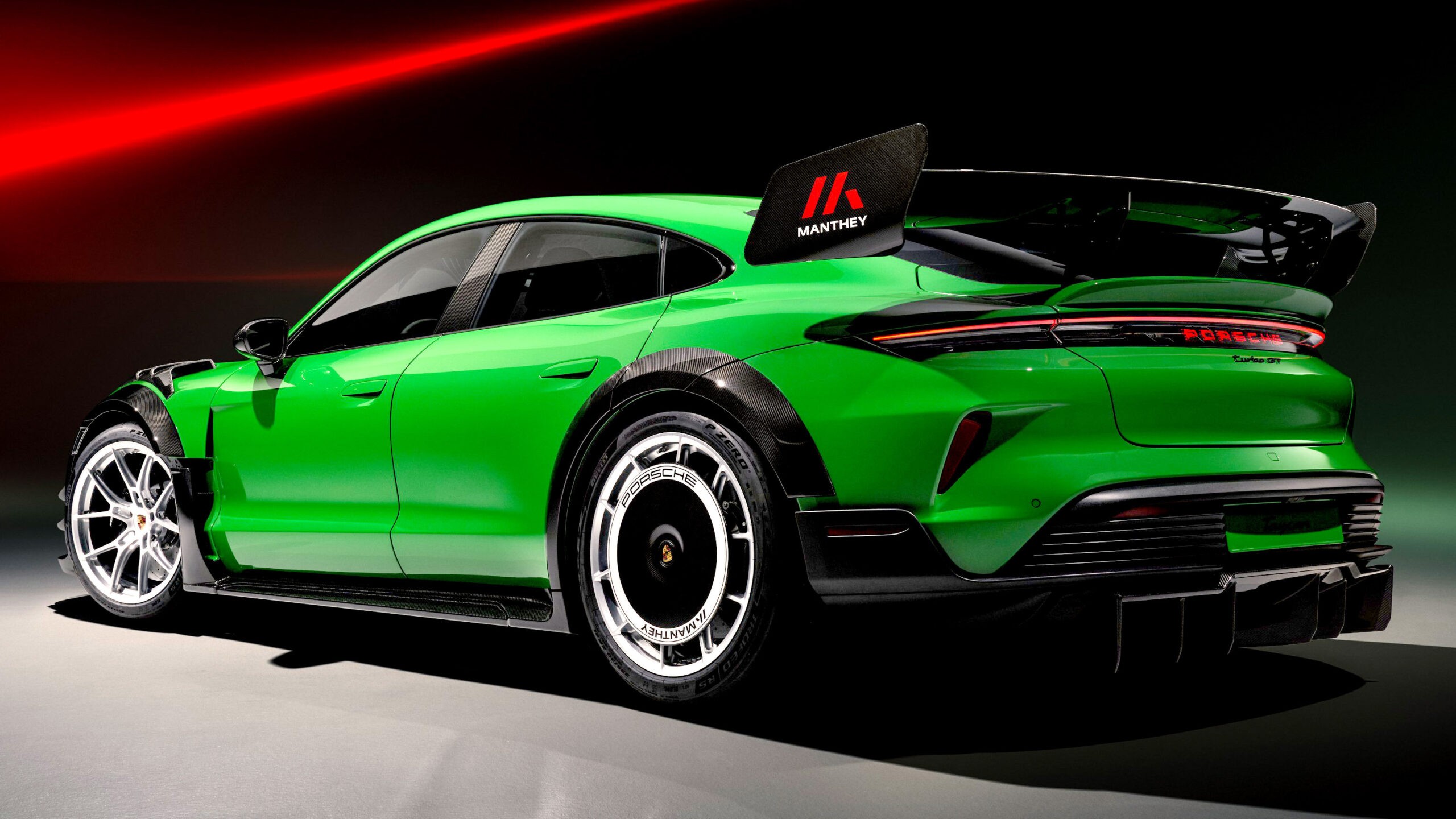
Porsche has officially reclaimed the title of the fastest production electric vehicle on the Nürburgring’s “Green Hell.” The German automaker achieved this feat with a heavily modified Taycan Turbo GT, enhanced by a new performance package developed in collaboration with racing specialists Manthey.
Driving the car, Porsche development driver Lars Kern set a lap time of 6:55.553. This result is significant not just for its speed, but because it ends a brief period where Chinese manufacturer Xiaomi held the crown. The new Porsche time is more than nine seconds faster than the production-spec Xiaomi SU7 Ultra, which previously recorded a lap of 7:04.957.
Key Context: While Xiaomi’s prototype recorded a blistering 6:22.091 in June 2025, that figure does not count toward official production records. Porsche’s achievement validates the Taycan Turbo GT as a legitimate track weapon, proving that established engineering can still outpace newer, raw-power-focused competitors.
Engineering a Track Weapon
The performance jump is not merely a software tweak; it is the result of a comprehensive hardware overhaul. The Manthey Kit was developed jointly by Porsche’s Weissach center and Manthey engineers in Meuspath, drawing directly from motorsport heritage. The goal was to transform the already potent Taycan Turbo GT into a dedicated track car.
The modifications focus on three critical areas: aerodynamics, powertrain efficiency, and weight reduction.
Aerodynamic Dominance
Visually, the car resembles a race car. The front end features an adjustable carbon fiber splitter, canards, and GT3-style gills on the fenders. The side profile includes wider fender extensions and deeper skirts. At the rear, a larger, manually adjustable wing and a boxier diffuser replace the standard equipment.
The aerodynamic gains are substantial:
* Downforce Multiplier: The kit generates more than three times the downforce of the standard model.
* At 200 km/h (124 mph): Downforce increases from 95 kg to 310 kg.
* At Top Speed (309 km/h): Downforce reaches 740 kg, allowing for a top speed increase of 5 km/h over the standard model.
Power and Weight Reduction
Under the hood, the electric powertrain has been retuned for higher output:
* Standard Mode: 804 hp (up from 777 hp).
* Attack Mode: 978 hp (up from 938 hp).
* Launch Control: Peak output remains at 1,019 hp, but torque increases by 22 lb-ft to 936 lb-ft.
Despite these gains, the Taycan still produces less raw power than the Xiaomi SU7 Ultra, which boasts 1,526 hp. However, Porsche’s strategy prioritizes handling and grip over brute force. To support this, the car features:
* Lighter Wheels: 21-inch forged aluminum wheels with carbon aero discs on the rear axle.
* Unsprung Mass Reduction: Titanium bolts save 6 pounds (2.7 kg).
* Suspension Tuning: Revised Porsche Active Ride suspension and four-wheel steering systems.
* Braking: Upgraded 440 mm front discs with performance pads.
Why This Matters
This development highlights a shifting dynamic in the electric vehicle market. While Chinese manufacturers like Xiaomi are aggressively pushing raw horsepower and battery capacity to break records, established European brands like Porsche are doubling down on engineering refinement, aerodynamic efficiency, and track-proven reliability.
The Manthey Kit demonstrates that for high-performance EVs, aerodynamics and chassis tuning can be just as critical as motor output. By adding significant downforce and refining power delivery, Porsche has created a car that translates power into speed more effectively on a demanding circuit like the Nürburgring.
Conclusion
Porsche’s Manthey-prepped Taycan Turbo GT has successfully dethroned the Xiaomi SU7 Ultra as the fastest production EV at the Nürburgring. With a lap time of 6:55.553, Porsche proves that sophisticated engineering and aerodynamic precision remain decisive factors in high-performance electric racing, reclaiming the title from its newer, power-heavy competitor.