


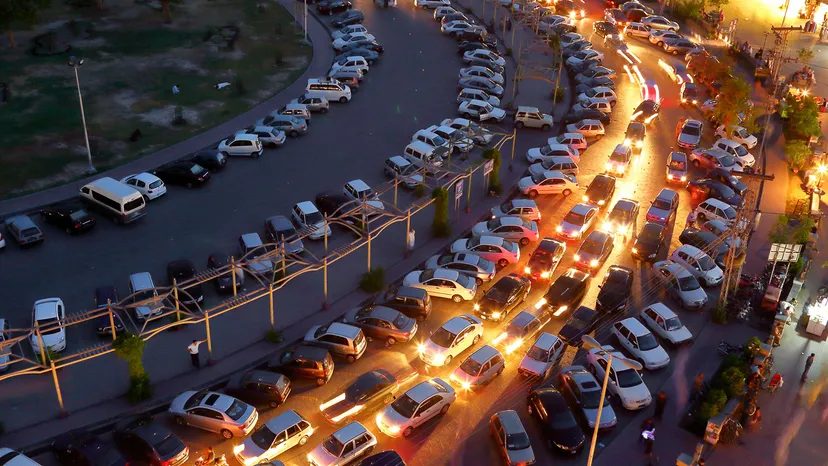
It’s Saturday afternoon. The shopping center was full. There is enough work, but the parking lot is a sea of metal. You have to make trivial choices until you get really stuck. Do you pick the first spot you find, no matter how far from the entrance, or do you drive up and down the aisles looking for that elusive spot near your house?
Most of us drive around. Let’s ride our bike in the driveway. We’re sure the perfect location is just around the corner.
According to our calculations, we are wrong.
Parking lot physics
In September 2019, two physics professors applied mathematical tools to this common everyday battle. Sidney Redner of the Santa Fe Institute and Paul Krapivski of Boston University published their research in the Journal of Statistical Mechanics. Their goal is to determine the optimal parking space search strategy.
Their definition of “best” is narrow. This means the location closest to the mall entrance. They do not take into account the height of the garage and the fear of the door closing. They want pure efficiency.
The researchers divided the drivers into three different roles.
First, a oblivious driver. They found the first opening. This behavior leaves spots near the front unfilled. You can get there reliably even if you walk long distances.
The other is an optimistic driver. they refuse to give up. They toured the property many times and were sure they would find a better place. They prioritize hunting over arrival.
Third, be a careful driver. This group is aggressive, but there are limits. They circled the first available location, hoping to find one closer. However, they do not cycle endlessly. If they don’t find a better option soon, they’ll go back to where a more oblivious driver would choose.
The simulation uses probability theory and speed equations. The results are clear. If you plan your strategy carefully, it will take the least amount of time for the driver. Optimistic strategies are in second place. Oblivious strategies take the most time.
Redner emphasizes that this is a purely mathematical exercise. The group minimizes the free parameters. They defined the same speed for walking and driving. Not all variables can be taken into account.
“The main complexity is the multi-part nature of the parking process,” Redner said. “You don’t know in advance which locations are free. The key to the game is whether you choose your current location or try another one.”
Real world variables are ignored. Driver speeds vary. The competition for places is getting tougher. Human irrationality begins to spread.
The real world of parking
Mathematics does not tolerate the human element. Are there strategies that take into account the idiosyncrasies of real people?
Andrew Wilkie, assistant professor of psychology at Christopher Newport University, says parking is an addictive game. Your success depends on what others do.
“This is a neat application of game theory,” explains Wilkie. “My optimal strategy is only better if other drivers choose one of the other alternative strategies. If everyone tries the same parking strategy, it is no longer an optimal strategy.”
Most people spend a lot of time looking for the nearest location. The ideal space is often not available. Time and perceived scarcity guide our decisions. We strive to shorten the travel time from your car to the front door. This increases the cost of acquisition time.
People spend extra time looking for a place near the gym or club entrance. They overestimate the availability of these facilities. They also overestimate their chances of getting these things.
If we miss the place in front of us, we get stuck in the counterfactual thinking. I find myself thinking, “I wish I could run more.” We remember when we were ahead. We forget the time we spend endlessly circling and never getting anywhere.
Select a row and move to the nearest row
Velkey referred to an article published in 1998 in the journal Transportation Science. The authors identify the optimal strategy for realistic situations.
This method is called Pick a Row, Closest Space (PRCS).
Instead of looping through the rows and looking for a closer location, it chooses a row randomly. Then move to the nearest obvious space in the column.
It saves you time looking for a place, which makes up for the long walk to the front door. The savings are small but consistent. In this model, the expected time to reach the front door using PRCS is 61.31 seconds. With the random search, it would be 70.70 seconds.
This 10-second difference increases even more every time you park your car thousands of times.
Planning is important
There is only one strategy. The layout of the plot is another matter.
A British maths professor believes that the design of car parks can have a huge impact on efficiency. Sites with diagonal spacing can reduce congestion. Improve traffic flow. It works better than many patterns that use traditional grid patterns.
The geometry of the space determines how traffic moves. A driver’s strategy determines how much time is wasted.
You might think you know the best way to park your car. You might think you can find that front row. But calculations show that it is better to accept a place in a random column. In physics, a cautious approach is said to be successful. According to psychology, you can never believe it.
Get in line. Take the empty space first. Please go a little further. Save time. You just feel like a loser.


