Preston Tucker was not just a car guy. He was a six-foot, 200-pound force of nature who could raise capital faster than most people can say “bankruptcy.” By the late 1940s, he had already burned through a resume that included sales stints at Studebaker and Dodge, plus a stint securing Henry Ford’s money to build Indy race cars back in 1935. He even had a high-speed military scout car ready by 1937. So when he dropped “The Most Completely New Car in Fifty Years” in 1948, the industry had no choice but to pay attention.
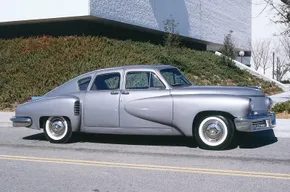
The result was the Tucker 48, a torpedo-shaped fastback four-door sedan that looked like it had just rolled out of a sci-fi novel. War-weary Americans were hungry for the future, and Tucker delivered it. Styled by Alex Tremulis, the car sat on a 128-inch wheelbase. It stretched 219 inches long but stood a mere 60 inches high. That low profile wasn’t just for show. It was engineering heresy in Detroit.
Detroit liked rigid axles. Tucker gave us all-independent suspension. Detroit preferred transverse engines. Tucker mounted a flat-six in the rear. That engine was derived from a wartime helicopter unit but featured a fully sealed water-cooling system—an industry first. It produced 166 horsepower and a thumping 372 pound-feet of torque from 335 cubic inches of displacement. The whole all-alloy powerplant weighed just 320 pounds. The chassis was a box-section perimeter frame with subframes at each end. It was heavy, yes. The car tipped the scales at 4,200 pounds. But it could still sprint from 0 to 60 mph in about 10 seconds. Top speed? At least 120 mph.
The aerodynamics helped. The drag factor was estimated at 0.30. That is still competitive by modern standards. Factory tests recorded a respectable 20 mpg at a steady 50 to 55 mph. The rear-engine layout, combined with all-independent suspension and center-point steering, made the massive sedan handle surprisingly well. It held the road with confidence.
Tucker wanted to push further. He wanted curved windshields. He wanted disc brakes. He wanted “Torsilastic” rubber springs. Time, money, and technology didn’t allow for it. But what he did include was packed with novelties. A central “cyclops-eye” headlight turned with the front wheels for better cornering visibility. Doors were cut into the roof to help passengers climb in and out. The cabin sat on a “step-down” floor, offering room for six passengers. Front and rear seats were interchangeable to even out upholstery wear.
Safety was a major selling point. Massive bumpers. Recessed knobs and levers so they wouldn’t hurt you in a crash. Windshield glass designed to pop out harmlessly on impact. And the “Safety Chamber.” Front passengers could dive forward into a protected zone in case of an impending collision.
Preston Tucker didn’t just build a car. He built a statement that terrified the Detroit establishment.
The projected price was around $4,000. That was Cadillac money. Yet, the car probably would have sold well if it had actually reached the public. It didn’t. Production ended at 50 cars plus the famous “Tin Goose” prototype. All were built before August 1948. The last 37 rolled off a short assembly line in a refurbished wartime Dodge plant on Chicago’s South Side.
Tucker claimed the car was too good to live. Evidence suggests the Detroit bigwheels felt threatened. But Preston doomed the venture himself. He moved with suspicious haste to issue $15 million worth of stock to finance the project. This triggered charges of “fast-sell” tactics. The Securities and Exchange Commission launched a probe. The resulting adverse publicity killed the deal.
In October 1949, Tucker and seven associates faced trial on 31 counts of conspiracy and securities and mail fraud. They were acquitted in January 1950. The jury called the proceeding a farce. Ironically, the Tucker Corporation still had funds to keep building cars. Public confidence was gone, though. Receivers briefly considered continuing production before auctioning everything off at 18 cents on the dollar. The dream was dead.
Tremulis later sketched a stunning fastback coupe called the Talisman as a proposed new ’50s Tucker. Preston apparently held onto hopes of building a car even after the Chicago ordeal. Broken by the experience, he moved to Brazil. He was planning a two-seat kit sports car, the Carioca, when he died on December 26, 1956. He was only 53.
The saga has been committed to film in Tucker: The Man and His Dream, released in 1988. Francis Ford Coppola’s direction is good drama, but he plays fast and loose with facts. Preston did the same. The closing “parade” sequence shows most every Tucker built, including two owned by Coppola. But those cars never made a triumphant procession right after the verdict. Nor did they parade through unpredictable springtime Chicago weather. You shouldn’t fret over the Tuckers that get smashed in an earlier scene either. They’re replicas.
The real story is quieter. It’s about a man who saw what was possible and got crushed by the weight of what was practical. The Tucker 48 remains a ghost. A ghost that still looks better than most cars on the road today.