Most drivers assume the internal combustion engine is the only way to move a vehicle. Heat and cooling happen inside the cylinder block. It works. It’s ubiquitous. But there is an alternative path. The external combustion engine moves heating and cooling outside the main power structure. It sounds like a step backward. It isn’t. It is actually quite efficient.
Two distinct types have powered automobiles: the steam engine and the Stirling engine. Both offer specific advantages that modern engineering is only now beginning to fully leverage.
The Steam Engine’s Forgotten Speed
Steam engines started in heavy machinery. Trains. Farm equipment. They proved themselves under massive loads. That proof was enough to bring them to roads.
Once a steam engine reaches full heat, pressure stays consistent. No gear hunting. No complex transmission needed. The car just moves.
Take the Stanley Rocket. In 1906, it hit 127 miles per hour. That is 204.4 kilometers per hour. That speed record stood for decades. Steam cars didn’t vanish overnight. They competed against early gasoline cars for years. Why? Because starting an early internal combustion engine was dangerous. You had to hand-crank it. It could kick back and break your arm. Electric starters hadn’t been invented yet. Steam engines just turned on.
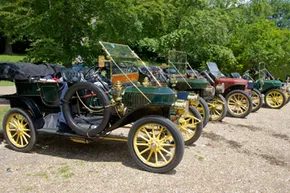
Convenience won, though. Around the time Ford launched the Model T, electric components made gasoline cars easier to use. Cost killed the steam market. Popular steam cars cost about six times as much as a mass-produced Ford. They died out slowly. Now, they are curiosities. Jay Leno collects them. Vintage examples survive because they are reliable.
But researchers still look at them. The efficiency of the steam engine, combined with modern technology, suggests a potential comeback.
Stirling Engine: Heat from Outside
The Stirling engine was developed by a Scottish inventor in the early 1800s. It also powered early automobiles. Its popularity stalled quickly. The materials available then couldn’t withstand the extreme heat required to run it. The engines melted or failed.
The Stirling engine uses pistons like a steam engine. But the heat source is external. Now, we have stronger materials. We have better metallurgy. The Stirling has fresh potential.
It can run on any type of fuel. That flexibility inspired Detroit automakers. They experimented with the Stirling during the 1970s. They saw the versatility. They saw the theoretical efficiency.
More recently, in 2012, a Stirling-powered car entered the Shell Eco-marathon Europe. It was a competition for experimental alternative-fuel vehicles. The car didn’t meet the contest’s qualifications. It couldn’t race. It failed to qualify.
But it succeeded in getting people to consider the Stirling engine once again. The materials are better now. The designs are sharper. The interest is back.
Lots More Information
The efficiency of the steam engine, combined with modern technology, gives steam-power plenty of potential for a comeback.
The shift back isn’t about nostalgia. It’s about thermodynamics. Internal combustion engines waste heat. External combustion engines can capture more of it. They operate on different principles. They don’t need the complex valvetrains of a gasoline engine. They don’t need the high-speed reciprocating parts that cause wear.
The Stirling engine is quiet. It runs smoothly. It doesn’t explode inside the cylinder. It heats a gas externally. The gas expands. It pushes the piston. It’s clean. It’s efficient. It’s just hard to make small enough for a car. Early attempts failed because of material limits. We have passed those limits.
The Stanley Rocket’s speed record from 1906 reminds us that alternative power isn’t new. It’s just been sidelined. The cost of steam cars was the killer in the early 20th century. Today, manufacturing costs are different. Supply chains are different. The barriers are technical, not just financial.
Detroit’s 1970s experiments showed the intent. The 2012 Shell Eco-marathon entry showed the attempt. The result was failure on paper, but success in awareness. The conversation has restarted.
Modern researchers believe the external combustion path offers a viable route for future automotive design. Not for speed records necessarily. But for efficiency. For fuel flexibility. For a different kind of drive.
The internal combustion engine won the race a century ago. It doesn’t mean it’s the only way. It just means it was the most convenient way at the time. Convenience changes. Efficiency matters more now. The external combustion engine is still here. Waiting for the right moment.