


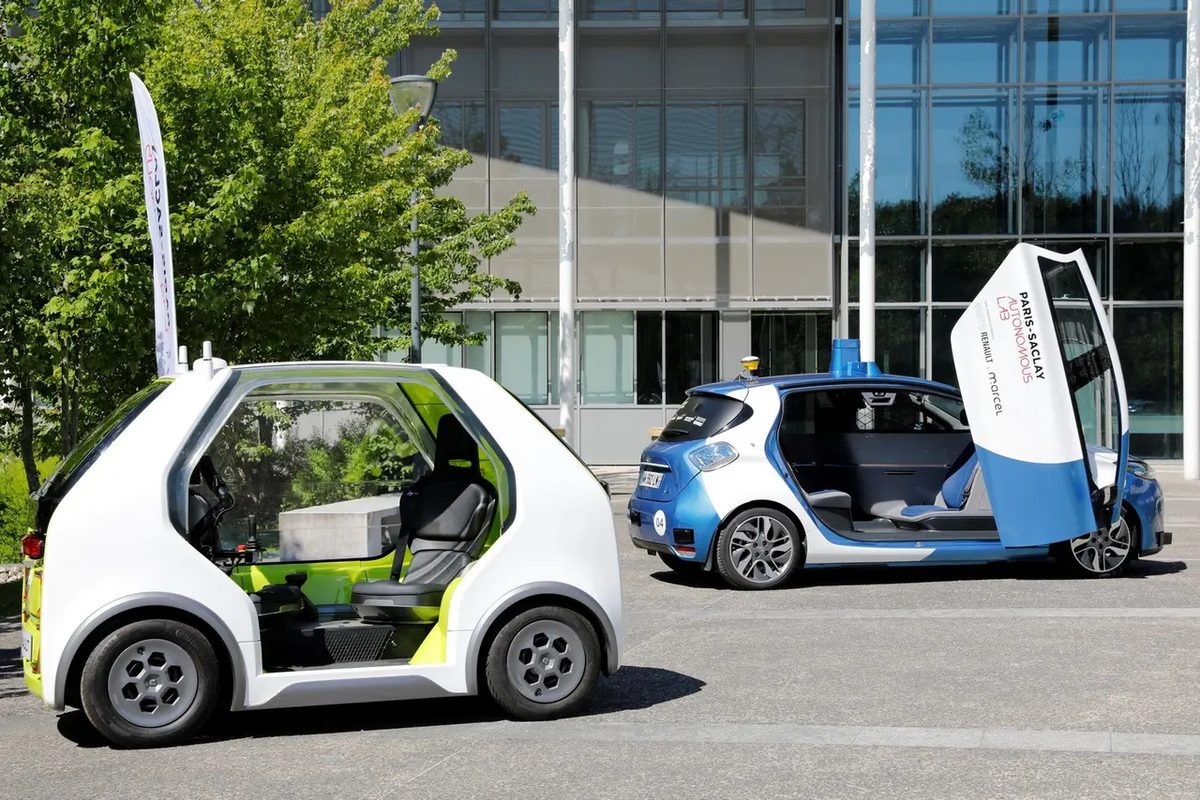
While Citroën was busy projecting its long-term future at Viva Technology with the bizarre 19_19 concept, Renault took a different tack. They didn’t look to the distant horizon. They looked at the street outside. The French automaker unveiled the EZ-Pod, an immediate solution for urban mobility that feels less like a sci-fi dream and more like a pragmatic response to gridlock.
The EZ-Pod: Twizy Bones, Robot Taxi Soul
Renault describes the EZ-Pod as an exploratory, electric, and autonomous vehicle designed for short-distance, on-demand travel. It’s not a car. It’s a pod.
The architecture is brutally efficient. Renault stripped the chassis down to its bare essentials, using the underpinnings of the Renault Twizy. That’s a two-seater quadricycle known for its narrow footprint. But the skin? That’s pure inspiration from the EZ-GO robot taxi we spotted last year.
The result is a vehicle with a mere 3 square meters of ground contact. It is micro-mobility redefined. Renault explicitly groups this thing alongside electric scooters and bicycles. It’s not competing with the Zoe. It’s competing with the sidewalk.
“A vehicle exploratory, electric and autonomous for short-distance on-demand travel.”
Where Can You Drive a 3-Square-Metre Pod?
The EZ-Pod isn’t trying to conquer the highway. Its cruising speed is low, which is a feature, not a bug. This sluggish pace allows it to operate in places cars are banned.
- Closed campuses
- Shopping centers
- Hotels
- Pedestrian zones
Because it moves slowly, the pod can pull up to the curb of apartment buildings and houses. It bridges the final meter. For elderly residents or families with strollers, that last 50 meters from the street to the door is often the hardest part of the journey. The EZ-Pod solves that friction.
Renault is also positioning the vehicle for logistics. The same autonomous platform can be converted into a delivery shuttle. Two different use cases. One chassis.
Beyond the Pod: The Paris-Saclay Autonomous Lab
The EZ-Pod is just the tip of the iceberg. Renault also showcased a second concept. This one is larger. It’s built on the platform of the Renault Zoe.
This project isn’t sitting in a vacuum. It’s part of the Paris-Saclay Autonomous Lab. Launched in mid-May, the initiative is a coalition of heavy hitters:
– The Renault Group
– Transdev Group
– IRT SystemX
– Institut Véhicule du futur (Vedecom)
– Université Paris-Saclay
The goal is concrete. They are developing autonomous transport systems for the Saclay plateau. These vehicles aren’t replacements for existing infrastructure. They are complements. They fill the gaps where buses don’t run frequently enough and taxis are too expensive for daily commutes.
Why This Matters Now
We’ve seen autonomous concepts before. Most of them are flashy prototypes stuck in testing phases. The EZ-Pod is different because it leverages existing manufacturing knowledge. The Twizy

The autonomous vehicle testbed in Massy-Palaiseau isn’t just about one car. It’s two distinct approaches to solving the same problem: what happens when the trains stop running? Two separate services are launching here. One uses a dedicated shuttle. The other repurposes a production electric hatchback.
The Night Shuttle: Lohr i-Cristal
First, there is the heavy lifter. Transdev and Lohr are testing the i-Cristal autonomous shuttle. This thing doesn’t run during peak hours. It hits the roads strictly between 00:30 and 03:00.
Why such odd hours? To fill the gap. The RER B and main trains have downtime. Buses don’t run everywhere late at night. The i-Cristal steps in. It starts at Massy station. It hits four specific stops:
– Massy-Palaiseau
– Palaiseau-Ville
– La Vallée
– Camille Claudel
It doesn’t play in traffic lanes. The i-Cristal sticks to the reserved bus lanes. It uses existing bus stops. This isn’t a gimmick; it’s about integration. The goal is seamless continuity. You get off the train. You hop on the autonomous shuttle. You don’t have to figure out a new payment system or a new route map. It’s designed to disappear into the existing transit network.
The Daytime Solution: Renault Zoe Cab
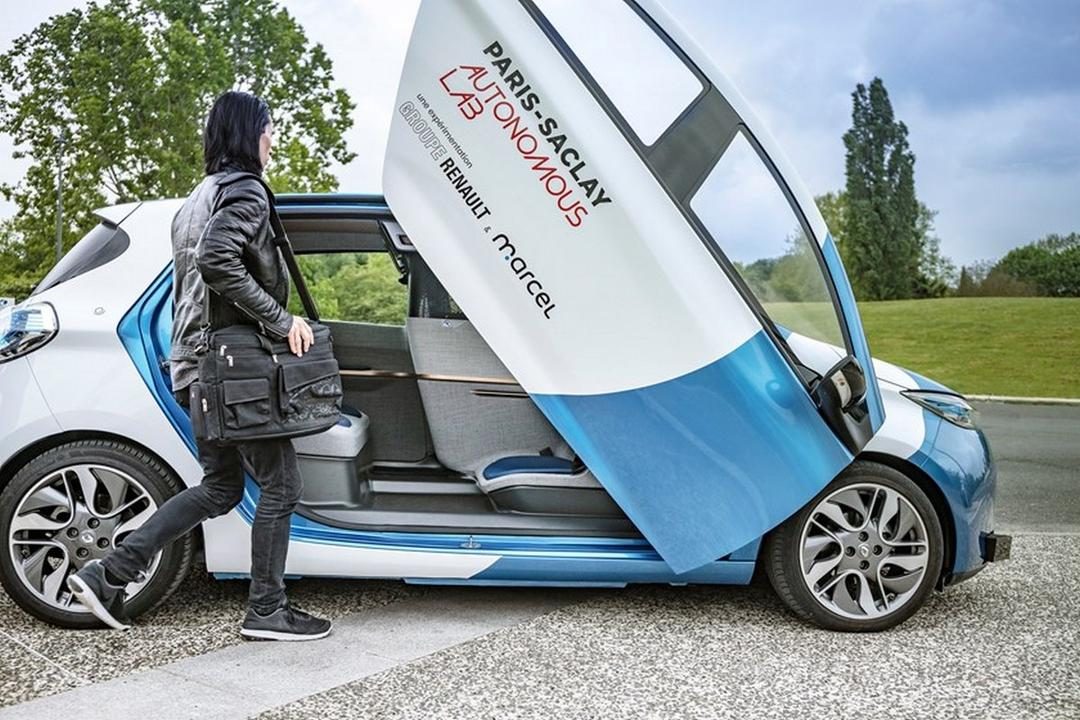
Then there’s the daytime play. Renault is deploying the Renault Zoe Cab. This isn’t a stock Zoe. It’s a modified version of the electric city car, stripped down and reconfigured for autonomy.
They didn’t just mount sensors on a standard hatchback. They physically altered the body. The standard two right-side doors are gone. In their place: a single butterfly door. No steering wheel. No pedals. The driver’s seat has been yanked out completely.
Inside, it’s tight. The Renault Zoe Cab fits exactly three passengers. That’s it. No cargo space for luggage. Just people.
The service operates on demand. You don’t wait at a fixed stop like with the shuttle. You use a mobile app. You request a ride. The Zoe Cab navigates to a pre-designated meeting point. It picks you up. It drops you off. This service targets the Paris-Saclay campus. It’s a loop-based solution for students and staff who need flexible, short-haul transport during working hours.
Why Two Cars? Why Two Models?
Renault isn’t throwing money at random tech. This is a controlled stress test. The objective is to define the conditions for scaling autonomous mobility. But they aren’t just looking at the code. They’re looking at human behavior.
The i-Cristal tests public transit integration. Does it work when people expect a bus? Does it run on time? Is it safe in mixed lanes?
The Renault Zoe Cab tests on-demand personal mobility. Is the butterfly door intuitive? Is three seats enough for practical use? Do people trust an app to bring a driverless car to them at 9 AM?
“Définir les conditions de déploiement d’un service de mobilité autonome à


