Every car rolling off a modern assembly line is a study in compromise. You aren’t buying a pure machine. You’re buying a product that had to fit into a specific price bracket, meet strict emissions regulations, and survive for decades on a single owner’s driveway. These constraints kill performance. They force engineers to choose efficiency over power, reliability over raw speed. But this is good news for enthusiasts. Because if a stock engine was designed to be mediocre, it can be improved.
There are many ways to squeeze more horsepower from a factory motor. Some methods cost next to nothing. Others require a credit card and a garage full of tools. Let’s look at the progression from the easiest tweaks to the expensive hardware swaps.
ECU Tuning and Remapping
The easiest starting point is the brain of the car. The Engine Control Unit (ECU) manages fuel, ignition timing, and air intake. Sometimes, you can simply swap out the Read-Only Memory (ROM) chip. This is the old-school way of modifying performance. You buy a pre-programmed chip from an aftermarket dealer. It plugs into the ECU and changes the engine’s behavior.
But here is the catch. Not all chips are created equal. Some promise the moon. They deliver nothing. You need to read independent reviews before spending money. If a chip doesn’t have real-world data backing it up, skip it. Modern cars often use flashable ECUs instead of physical chips, but the principle remains the same. You are altering the software to allow for more aggressive timing and fuel maps.
Improving Airflow: Intake and Exhaust
Engines breathe. They pull in air, mix it with fuel, and burn it. Then they expel the exhaust. If either process is restricted, power drops.
The Intake Side
As the piston moves down during the intake stroke, it creates a vacuum. If the air path is narrow or rough, it creates resistance. This resistance robs power. Some newer performance cars come with polished intake manifolds to smooth out the air path. You can replicate this effect by upgrading to a high-flow air filter. Larger filters allow more air to enter the engine. Shorter, smoother intake piping also helps. The goal is to reduce turbulence. Less turbulence means more consistent airflow. More airflow means more combustion. More combustion means more power.
The Exhaust Side
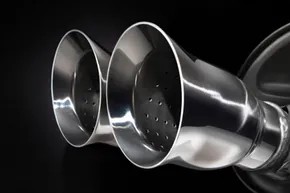
Exhaust gas must exit the cylinder quickly. If it lingers, it creates back-pressure. Back-pressure is the enemy of horsepower. It happens when the exhaust pipe is too small or the muffler is too restrictive. A high-performance exhaust system solves this. It uses headers to collect exhaust gases efficiently. It uses large-diameter tailpipes. It uses free-flowing mufflers. The result is that the engine doesn’t have to work as hard to push out exhaust. This frees up power for acceleration.
Internal Engine Upgrades: Heads and Cams
If you want serious gains, you have to look inside the engine. Stock engines are designed for mass production. They use simple, cheap components. Performance engines use specialized parts.
Most stock engines have two valves per cylinder. One for intake. One for exhaust. This limits airflow. Upgrading to a cylinder head with four valves per cylinder doubles the airflow potential. This is a dramatic improvement. It allows

Packing more punch into every stroke
The math is brutal but simple. Bigger numbers mean bigger horsepower. But you don’t always need a V12 to get there. You can squeeze more power from a small engine by forcing more air into each cylinder. Think of it as cramming more oxygen and fuel into the same physical space. If you can fit more charge in, you get more explosion. More explosion equals more push.
Turbochargers and superchargers do exactly this. They pressurize the intake air so the engine inhales denser air than it would at sea level. It’s like taking a deep breath while holding your head underwater. Manufacturers sell aftermarket kits for all sorts of rides, from hot hatches to muscle cars. You buy the kit. You install it. You breathe deeper.
Chilling the charge matters
Here is the catch. Compressing air heats it up. Hot air is less dense. If you shove hot air into a cylinder, it expands less during combustion. You waste potential power. You also risk knocking.
That is why intercoolers exist. An intercooler is basically a radiator for the air. It sits between the compressor and the engine intake. The hot, compressed air passes through it and dumps heat to the atmosphere. Cooler air is denser air. Denser air packs more oxygen into the cylinder. The engine burns it more efficiently. The result is cleaner power and better efficiency. You get the pressure boost without the thermal penalty.
Shedding weight saves energy
Lightweight parts change how an engine behaves. It isn’t just about top speed. It’s about responsiveness. Consider the piston. It moves up and down hundreds of times per second. Every time it changes direction, kinetic energy is lost. It takes effort to stop the piston going up so it can come down. It takes effort to stop it coming down so it can go up.
Heavier pistons demand more energy to reverse direction. That energy comes from the crankshaft. From the power you are trying to use to move the car. Lighter pistons require less energy to change direction. The engine spins up faster. Revving becomes easier. Horsepower gains follow naturally because less power is wasted on inertia.
The compression ratio gamble
You can also squeeze more power by increasing the compression ratio. This means squeezing the air-fuel mixture tighter before the spark plug fires. Higher compression leads to a more forceful explosion. More force equals more torque.
There is a limit. Push it too far and the mixture ignites spontaneously. This is called detonation or knocking. The spark plug isn’t even supposed to fire yet. The pressure alone lights the fuel. That destroys engines.
High-octane gasoline raises the threshold for spontaneous ignition. It allows you to run higher compression ratios safely. This is why high-performance cars demand premium fuel. They are engineered to squeeze the mixture harder. Regular gas will cause the early combustion that blows up the engine. You pay for the fuel so you can pay for the power.
Displacement vs. swapping engines
The most direct way to add power is increasing displacement. Bigger cylinders mean more fuel can be burned per revolution. You get more torque. You get more power. It is the brute force approach.
But there is a reality check. Once you start thinking about boring out cylinders or swapping long blocks, look at the economics. You might be better