


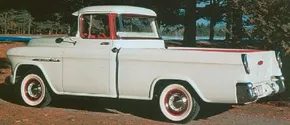
The 1955 Chevrolet Cameo Carrier wasn’t just a truck. It was a light-duty vehicle dressed in the skin of a passenger car, blending utility with a level of flair that had no business sitting on the assembly line next to a delivery hauler. Designer Chuck Jordan recalls the initial vision clearly. The original drawings showed the bodysides running flush into the pickup box. The cab and box were one continuous piece of sheetmetal. No seams. No gaps. Just a seamless, flowing profile.
Chevrolet’s engineering team killed that idea immediately. They warned that tying the entire structure together would cause excessive body torquing. The metal would wrinkle under stress. So the team redesigned the truck. They inserted a deliberate gap between the cab and the bed. An overlapping flange and a chrome strip hid the seam. The requirement was a strict ¾-inch clearance. To the designers, that gap looked massive. To the average buyer, it was invisible.
“This was something extra,” Jordan says. “Something beyond the ordinary.”
It was also a financial experiment. Chevrolet knew the Cameo wouldn’t be a volume seller. High-volume trucks need stamped steel. Low-volume, high-style vehicles need fiberglass body panels. That material choice was only possible because the Corvette had already paved the way. The Corvette program had established the manufacturing infrastructure for composite parts. The Cameo Carrier essentially freerided on that investment.
The result was a smooth-sided carrier. A conventional steel stepside box was hidden inside fiberglass outer skins. The fenders, tailgate, and spare-tire carrier were all molded from fiberglass. They attached to the exterior of the pickup box using concealed fasteners. This approach eliminated the visual clutter of bolts and hinges, keeping the lines clean.
The taillamps were vertical and faired directly into the bodywork. No chrome bezels interrupting the flow. The tailgate operated on a unique cable system. It swung down on cables that retracted through hidden, spring-loaded pulleys. The mechanism was complex. The aesthetic was simple.
Why build a truck that looks like a car when you could just build a car? Because utility doesn’t have to be ugly. The Cameo Carrier proved that fiberglass wasn’t just for sports cars. It was a cost-saving measure that allowed for shapes steel couldn’t handle. The gap between the cab and bed remained. It was a compromise between engineering reality and design desire.
The truck didn’t save the company. It didn’t even need to. It just needed to exist.
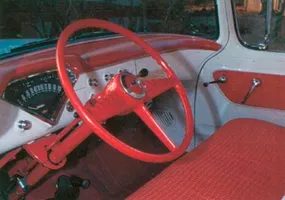

The Cameo’s Last Hurrah and Legacy
Moulded Fiberglas of Ashtabula, Ohio, handled all the fiberglass fabrication, the same shop that built the Corvette body. The Cameo Carrier kept that singular, stark aesthetic. Only one color scheme existed: Bombay Ivory with Commercial Red window accents. The interior was red-and-beige vinyl. Even the inside walls of the pickup box got painted red.
Chevy kept the Cameo alive through early 1958. It wasn’t cheap. Prices sat $350 to $475 above basic ½-ton Chevy pickups. Total production hit 10,321 units. About half of those moved during the short 1955 launch season. The numbers weren’t huge, but the impact was.
The Cameo didn’t need volume to matter. It was a halo. Think of it as the truck equivalent of the Corvette for passenger cars. It drew eyes. It defined the brand.
Jordan put it plainly. The Cameo’s influence rippled outward. Dodge responded fast. They introduced a fleetside box for their 1957 models. Suddenly, smooth sides became the norm. All trucks followed suit. The Cameo started the trend toward flush-sided pickup beds. It set a standard.
“Of course, the influence of the Cameo was considerable. Shortly after we introduced it, Dodge brought out a pickup with a fleetside box [for 1957], and from then on all trucks became available with smooth sides.”
So the Cameo, which didn’t sell in great numbers because it carried a relatively high price, started the trend toward flush-sided pickup boxes.
1955 Chevrolet Truck Lineup
To read about more 1955 Chevrolet truck models, see the next page.
For more information on cars, see:
- Classic Cars
- Muscle Cars
- Sports Cars
- Consumer Guide New Car Search
- Consumer Guide Used Car Search


