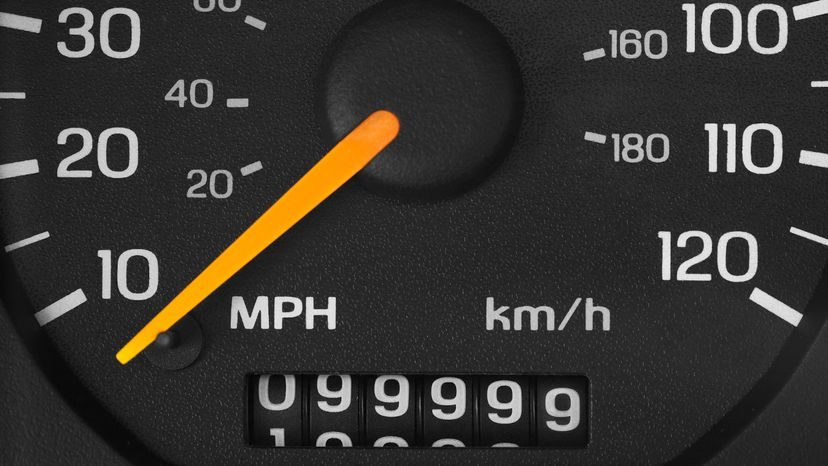
Mechanical odometers have measured miles for centuries. They’re a dying breed for sure, but let’s face it – they’re infinitely cooler than their digital counterparts because they’re so incredibly simple. A mechanical odometer is nothing more than a gear train with an incredible gear ratio. There is no code. No software. Just brass, steel, and physics doing the heavy lifting.
The particular unit we took apart for this article has a massive gear ratio of 1690:1. This number sounds abstract until you understand what it really means. This means that the input shaft connected to the transmission must rotate exactly 1,690 times before the odometer reads one mile from the dial. One mile. The 1,690 revolutions of the transmission are transmitted through a series of gears that move the needle or turn the drum. This is engineering as art.
These mechanical wonders are vanishing. Digital odometers replace them in almost all new vehicles. Why? Because digital devices offer more functionality and cost significantly less to produce. They are effective. They are practical. They also aren’t nearly as cool. There is a certain romance in watching a physical mechanism count down the distance, knowing that each tick is a concrete interaction between metal parts.
In this deep dive, we remove the plastic covers. We look inside the mechanical odometer to see how these gears relate to each other. Then we move into modern reality and talk about how digital odometers actually work, why they won the war, and what we lost in the transition.
Anatomy of a mechanical odometer
To understand how these things work, you have to stop thinking about electronics and start thinking about leverage. The core component is the gear train. It’s a series of gears, each one reducing the speed of the previous one and adding a bit of torque, although torque isn’t the main goal here. Accuracy is.
The input shaft rotates at a speed directly proportional to the wheels. If your tires are the right size and you drive at a steady speed, this axle will spin predictably. The transmission takes this fast rev and slows it down dramatically. In our example, it takes 1,690 input revolutions to produce one output revolution for a “100,000 mile” drum.
This ratio is exact. It is calibrated during manufacturing to account for tire size variations within acceptable limits. If your tires are larger than the original tires, the odometer will underestimate your mileage. If they are smaller, it is overestimated. This is a fundamental flaw in the mechanical system – it is based on the physics of the coupling and not on external calibration.
The numbers on the front are usually drums, like from an old mechanical lottery machine or a hotel key card machine. Each drum has ten faces, numbered from zero to nine. As the drum below makes a full revolution, it presses a small stem or peg into the drum above, moving it one digit further. It’s a transfer system. Simply. Resistant. Hard to break unless you smash it with a hammer.
Why digital odometers won
If mechanical odometers are so durable, so visual, and so satisfying, why aren’t they around anymore? The answer is price. Manufacturing
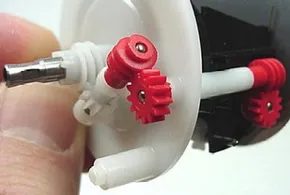
Mechanical odometers do not depend on digital signals. They are powered by a flexible cable consisting of a tightly wound spring. This cable runs inside a protective metal tube, often covered with rubber for durability. In a bicycle, a small wheel rotates against the tire to rotate the cable. The odometer gear ratio needs to be precisely calibrated for the size of this small wheel. Cars take a different approach. A gear is connected to the output shaft of the transmission to rotate the cable directly.
The cable snakes its way to the dashboard. There it is connected to the odometer input shaft.
Transmission
This odometer uses a series of three worm gears to achieve a 1690:1 gear ratio. The input shaft drives the first worm. The worm drives a gear. Each full revolution of the worm turns only one tooth of the gear. This gear turns the second worm. Another worm turns another gear. This last gear turns the last worm. The last worm drives the last gear. This gear is connected to the tenths of a mile indicator.
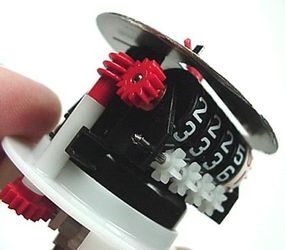
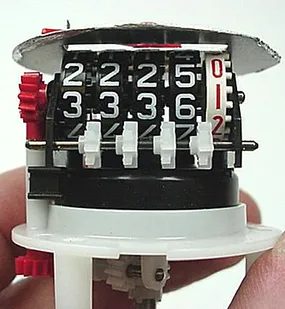
Look closely at the gears inside. Each indicator wheel has a special row of pegs that protrude from one side. There is one pair of two pegs on the opposite side. It’s a simple mechanical handshake.
As the pointer rotates, this pair of pegs sweeps over the white plastic gears. One of the gear teeth slides between two pegs. The gear rotates in time with the pointer until the pegs slide past. This engagement is the heart of the mechanism.
But the movement doesn’t end there.
This gear also catches a peg on the next larger indicator. Result? A tenth of a revolution. It’s a cascading effect. Each dial controls the next, moving numbers forward in precise, mechanical increments. No electronics. Just tooth and peg.
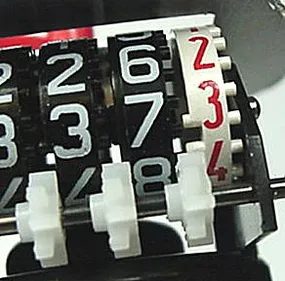
“翻转”效果不仅仅是视觉上的怪异。 当里程表达到整数(例如 20,000 英里)时,您会看到轻微的错位,这可以归结为齿轮间隙 。 白色辅助齿轮中的间隙很小,导致在某些点上无法完美对齐。 通常,在达到 21,000 之前,数字不会再次排列。
机械里程表是可倒带的。 在老式汽车中,倒车实际上可能会导致计数器向后运行。 一些制造商添加了阻止这种情况的机制,确保里程只会增加。 您可能见过“费里斯·布勒的休息日”中的场景,汽车停在街区上,车轮反向旋转。 事实上,这应该可以使里程表转回来。 另一个技巧是将里程表电缆挂在钻头上并向后运行。
这适用于旧的机械装置。 它不适用于新的电子系统。
Computerized Odometers
If you go to a bike shop, you won’t find a cable-controlled speedometer. You will find a bike computer. magnets are used in the wheels and pickups are used in the frame. Every time the wheel spins, a magnet passes over the pickup, creating a voltage spike. The computer counts these pulses to calculate the distance.
You need to program the circumference of the wheel into these devices. Each time the computer detects a pulse, it adds that distance to the total distance.
Modern cars use the same logic. Gamnets and magnetic sensors are used instead of magnets in the transmission output. Some use optical pickups such as slotted wheels or mouse sensors. The car’s computer recognizes the distance of each pulse and updates the odometer accordingly.
However, this is an important distinction. Distance data is not transmitted via the spinning cable. They are sent from the engine control unit (ECU) to the instrument panel via a single wire communications bus. The car is basically a local area network.
Devices connected to this network include the following.
- Engine control unit (ECU)
- Climate control system
- Dashboard
-Power window controls - Radio
- Anti-lock braking system (ABS)
- Airbag control module
- Body control module
- Transmission control module
Many vehicles use the SAE J1850 protocol to allow these modules to communicate with each other.
The ECU counts each pulse. It keeps the master record of total distance. This makes it difficult to reverse the odometer. If someone tries to change the readings on the dashboard, the ECU values will be inconsistent. This stored value can be read by the dealer using the diagnostic computer.
The ECU sends data packets several times per second. Each packet has a header that identifies the distance information and the actual distance traveled. The dashboard computer is looking for that specific packet. When it sees one, it updates the display. Digital dashboards just show the new number. Analog odometers use a small stepper motor to turn the dial.
更多信息
Related HowStuffWorks Articles
- How Gear Ratios Work
- How Car Computers Work
- How windshield wipers work
- How electric door locks work
- How electric windows work
- How the fuel gauge works
- How a bicycle works
- Rollover Accidents Explained
- The 1967 Pontiac GTO Explained
- 1965 Oldsmobile Cutlass 442
- The 1967 Shelby GT 500 Explained
More Great Links
- Odometer history
- Speedometer/Odometer Calibration Program
- Automotive 101: The Electrical System (An Overview)
- The Federal Odometer Tampering Statutes
- Odometer Effect for Serial LCDs