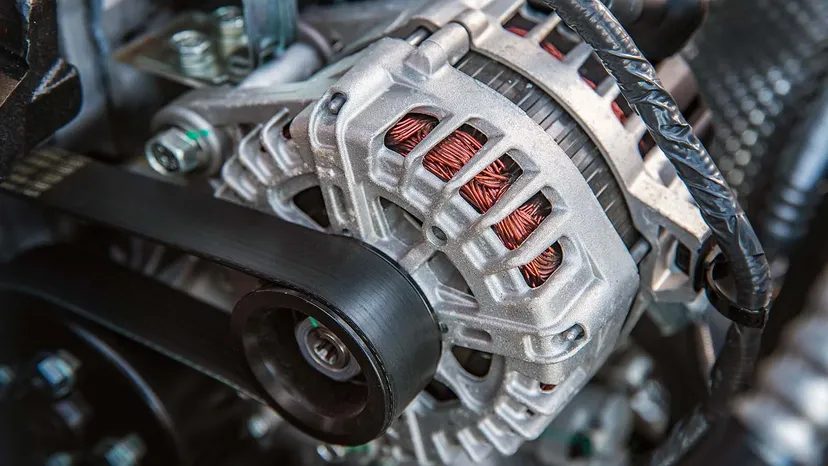
Most alternators are deceptively simple. It’s about the size of a coconut, light enough to hold in one hand, and wrapped in an aluminum case. Why aluminum? It doesn’t magnetize. This is the key. This metal dissipates the intense heat generated during power generation and prevents disturbances in the magnetic fields of the rotor assembly.
Let’s take a closer look at the case. You can see the vents in the front and back. These are not just for show. They allow air to flow and cools the device during use. The drive wheel is attached to the front of the rotor shaft. When the engine is running, the crankshaft rotates the drive belt. The belt rotates the pulley. The rotor rotates with the help of a pulley. simple physics. The alternator takes mechanical energy from the engine and converts it into electrical energy that powers your car’s accessories.
The back of the device is where the magic connects to the network. The circuit has several connectors or connection points. Everyone has a job:
- S terminal : Detects battery voltage.
- IG terminal : Connect to the ignition switch and turn on the voltage regulator.
- L terminal : Turns off the warning light circuit.
- B terminal : Main output connection connected directly to the battery.
- F terminal : Provides a full field bypass for the regulator.
Cooling is everything here. Older units often have external fan blades mounted on the rotor shaft behind the pulley. You can still see it in old cars. Modern alternators have a cooling fan hidden inside an aluminum case. It is powered by the mechanical rotation of the rotor shaft and works the same way, but is hidden from view and debris.
When you start this teardown, you’ll come across the diode rectifier (also known as the bridge rectifier), the voltage regulator, the slip ring, and the brushes. The regulator controls the power and the amount of charge going to the battery. A rectifier bridge converts alternating current. Brushes and slip rings transfer the current to the field winding of the rotor or the magnetic field of the line. It’s time to crack the coconut.
Inside the alternator
When you open it, you will see a large cylinder. It is surrounded by triangular finger poles. This is the rotor. A basic alternator consists of alternating finger-shaped pole pieces placed in a coil wires called the field winding. These windings are wound around the iron core of the rotor shaft.
Since we know that the pulley is connected to this shaft, we can imagine that the rotor rotates inside the stator. There is enough tolerance between the two components to allow the rotor to spin at high speeds without hitting the stator walls. Both ends of the shaft have brushes and slip rings.
How does it generate electricity? Magnetism. The triangular finger poles are arranged in a staggered pattern. This means that the poles alternate between the north and south poles as it goes around the rotor field windings. The magnetic field created by this changing pattern induces a voltage in the stator. Think of the stator as a catcher’s glove. It captures all the power produced by the rotating rotor.
These components work together to provide the power your vehicle needs. At least that’s the theory when everything is new and clean.