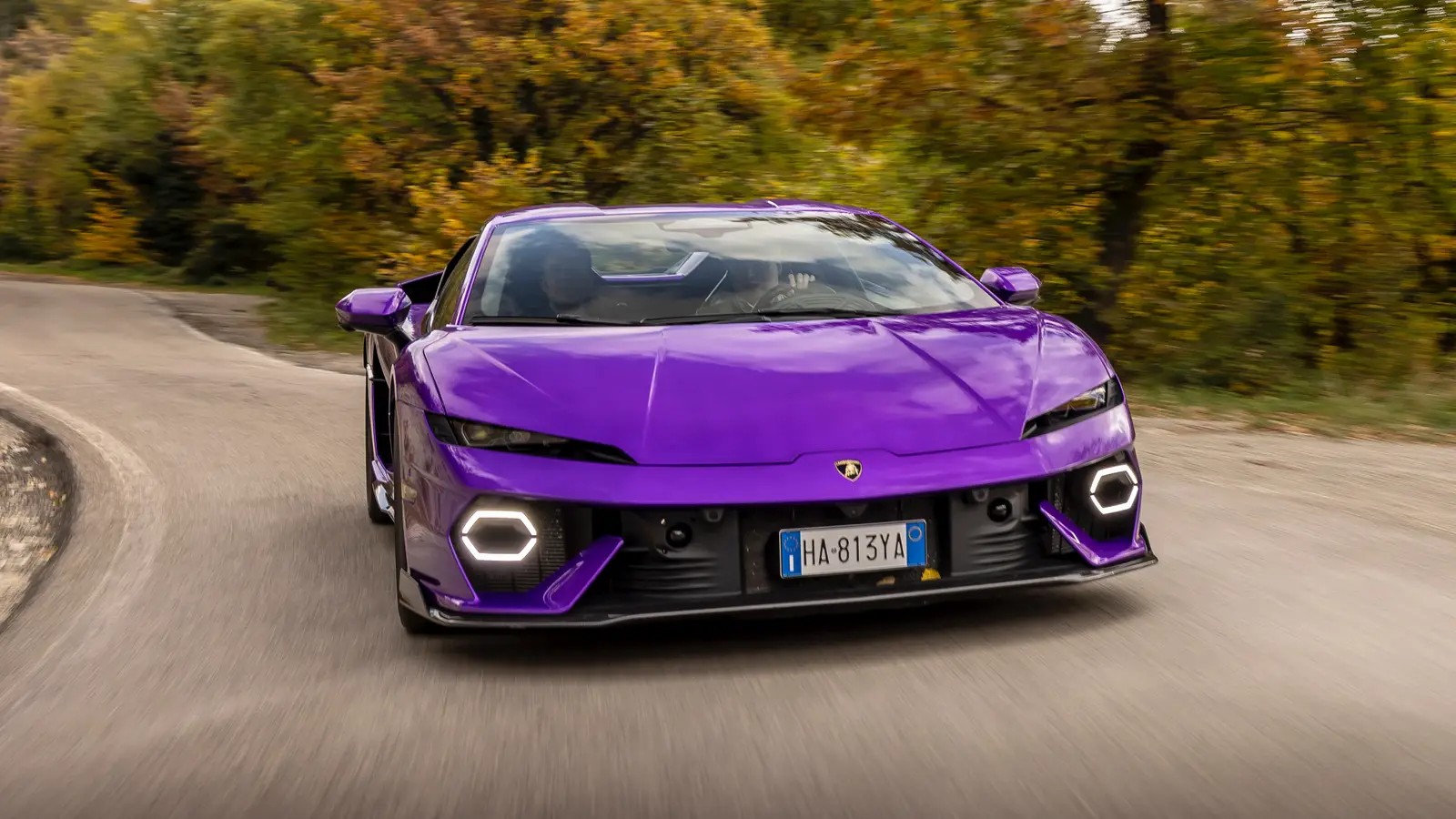
The Huracán is gone. The 5.2-liter naturally aspirated V10—that 630-horsepiece screaming past 8,500rpm, the engine that defined Sant’Agata’s modern era—is history. In its place sits something that would have seemed like science fiction five years ago: a twin-turbocharged 400cc V8 mated to a hybrid system.
It sounds wrong on paper. It should feel like a compromise.
But Car & Driver’s recent road test of the 2026 Lamborghini Temerario suggests otherwise. The headline finding isn’t just about horsepower figures. It’s that the Temerario refuses to feel like the “junior” supercar in Lamborghini’s lineup. And for a brand that built its identity on screaming analog engines, that might be the most dangerous—and impressive—statement it could make.
How the Lamborghini Temerario Hybrid V8 Works
Let’s cut through the marketing fluff. The Lamborghini Temerario hybrid powertrain pairs a twin-turbo V8 with an integrated electric motor system. Combined output? Substantially more than the 631 horsepower the Huracán STO made.
But here is the nuance most spec sheets miss: this isn’t a fuel-economy hybrid. It’s a performance tool.
The electric motors don’t save gas. They fill the torque curve. Specifically, they plug the gap in the low-to-mid range where high-revving, naturally aspirated engines traditionally run lean. The V10 built power progressively as the revs climbed. This hybrid V8? It delivers a broad, flat torque band from way down low.
The result on the road? Acceleration numbers that place the Temerario right in line with the Huracán Performante. Maybe faster. It is worth noting that while the Temerario is the entry-level V8 model in Lamborghini’s current supercar lineup, the gap to the V12-hybrid Revuelto is narrower than the price tag suggests.
Is Turbocharging Killing the Lamborghini Soul?
This is the debate. And it is genuine.
Naturally aspirated engines have a specific character. Linear power build. Immediate throttle response. An engine note that climbs in pitch with every RPM. Turbocharging changes the physics. Boost lag. Peak torque arriving early. A different, often harsher acoustic profile.
Can a hybrid mask that lag?
Car & Driver’s review suggests yes. The electric motors provide near-instant torque while the turbos are spooling up. The lag is effectively invisible to the driver.
Does it replicate the analog feel of the old V10?
Probably not. And that depends entirely on what you value. If you want raw, unfiltered mechanical feedback at the redline, this is a step backward. If you want the fastest car Lamborghini has ever built to launch you out of a corner before you even think about turning the steering wheel, the Lamborghini Temerario is superior.
It is faster. Undeniably. Whether it is more satisfying is a philosophical question. Whether it is more capable is a mathematical one.
Temerario vs. The Competition: Ferrari, Porsche, McLaren
Lamborghini is not acting in a vacuum. The hybrid supercar formula is now the baseline. The Temerario enters a segment where rivals have already committed to electrification. But they are all doing it differently.
- Ferrari SF90 Stradale: Uses three electric motors with a twin-turbo V8 for 986 hp. More aggressive integration. Prioritizes outright performance. Loses some analog character in the process.
- Porsche 911 Hybrid: Takes a smaller, supportive approach. Layers electric assist onto a familiar flat-six. Preserves the 911’s traditional feel. Adds punch. Less power than the Temerario, but more familiar.
- McLaren Artura: Twin-turbo V6 hybrid. Lightest. Most focused. Least powerful at the top end of the segment.
The Temerario sits in the middle. It is more visceral than the Porsche. More driver-focused than the Ferrari. More powerful than the McLaren in base form.
The Verdict on the New Sant’Agata Formula
What distinguishes the Temerario from these rivals is intent. Lamborghini hasn’t just bolted on batteries to meet emissions regulations. They have tuned the chassis, the steering, and the dynamic balance to complement the hybrid delivery.
That is harder engineering than just making more horsepower. It requires making the car feel like a Lamborghini despite having two turbochargers and batteries underneath.
Car & Driver suggests the engineers at Sant’Agata nailed it.
The V10 era produced emotional masterpieces. We miss them. The sound alone is hard to replace. But the 2026 Lamborghini Temerario isn’t trying to be the Huracán. It is a recalibration of the Lamborghini identity for 2026.
The numbers are there. The performance is proven.
Does the soul matter when you are this fast?
Maybe. Maybe not. But the Temerario has at least started a new chapter. Whether it writes a better one than the V10 era remains to be seen.