


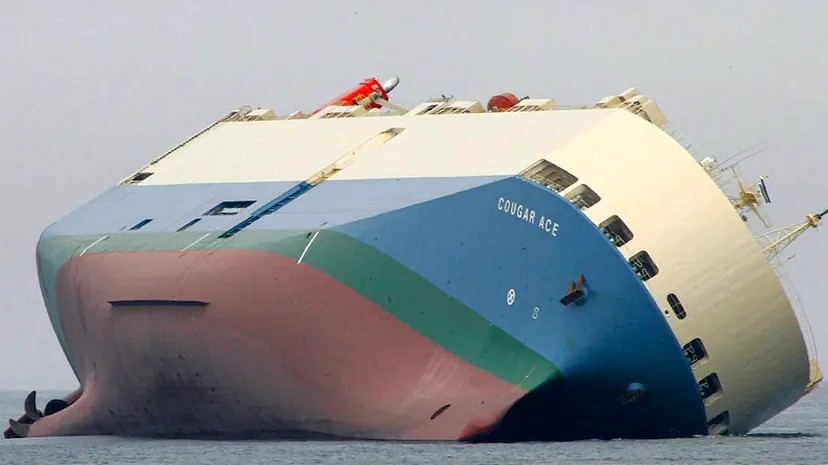
The majority of car disasters result in personal injuries. You hit a patch of ice. You misjudge a merge. Metal screams and your week is ruined. Disasters can be models of failure until they become a cultural joke. But the story of Cougar Ace is different. This is a story of logistics, physics and the decision to turn thousands of pristine vehicles into scrap metal.
“Cougar Ace” is no small player. Built in Japan in 1993, this car carrier is a beast. In 2005, it set a Canadian record by transporting 5,214 vehicles to the same port at once. By July 2006, it had reached the west coast of North America. On board: 4,800 vehicles. Almost all, 4,703 specifically, were brand new Mazda vehicles. The weight of the ship is 55,328 metric tons. The crew of 23 is confident. They weren’t worried.
Then, near the Aleutian Islands, everything went sideways.
The Ballast Tank Mistake
Ships use ballast tanks to keep them level. Regulations require crews to remove seawater from these tanks upon entering U.S. waters. This prevents invasive marine species from entering the local ecosystem. This process is routine. It’s even boring. However, there was a problem with the “Cougar Ace”.
The crew emptied the tanks. Seawater was not added to compensate for the weight loss. The result? The huge ship listed heavily to the port side. It didn’t sink. It just sat there, tilted, bobbing in the water like an overturned bathtub.
The crew escaped. One of the workers broke his leg. The rest of the personnel were evacuated within 24 hours. But the ship remains. A 655-foot hull, listing in the Pacific and holds thousands of cars suspended by nylon straps.
The Salvage Plan and a Fatal Error
A salvage operation was launched. Naval architect Marty Johnson drew up a plan to right the vessel. He calculated the amount of water needed for pumping, the angle to be reached and the associated risks. The plan was sound.
Johnson then died. He was killed in July 2005 (the original date conflicts with the July 2006 timeline of events, but the death occurred during the measurement phase). He fell. The tragedy casts a long shadow over recovery efforts.
By August, the salvage team implemented Johnson’s plan. They pumped water into the ship’s compartments. Slowly. Carefully. “Cougar Ace” begins to return to normal. In September it was towed to Portland. The cars were offloaded onto 50 acres of empty lots.
Only 68 vehicles were damaged. The rest were unaffected. Or so it seems.
“shipwreck” shame
Mazda has a problem. Thousands of cars were tied to the swaying hull of the ship and hung at odd angles for weeks. The company tested them. They could not determine for sure whether the stresses compromised the integrity of the structure. Nylon straps are flexible. Metal fatigue. Hidden damage is difficult to detect.
So Mazda made a decision. They don’t sell cars. No dealer would want a “wrecked car”. This will damage the brand. This can hurt the resale value. This undermines trust.
Workers dismantled the car. to everyone. They deployed every airbag. Drain off all liquid. Collect all the nuts and bolts. The goal is complete destruction. None of these Mazdas will ever be seen on the road again.
Our last stop was the Texas Shredder. The machine breaks the car into several parts. This is industrial violence on a large scale. Such was the fate of the “Puma Ace” cargo.
Waste management
The shredding company receives compensation based on the scrap value of each vehicle. I don’t know the exact number, but it’s usually around $250 per unit. That’s a fraction of the original price. Just a few.
But think about it. Cars that were once worth tens of thousands of dollars can now be bought for $250. This is one way to buy a car cheaply. If you like that. Unless you don’t mind being made of twisted steel and memory.
The “Cougar Ace” case reminds us of this. Cars are fragile. The logistics are complicated. In some cases, a small mistake can cause a metal stack. The sea doesn’t care about your guarantees. Shredder doesn’t care about your brand loyalty. Just eat.
To learn more, listen to this episode of CarStuff hosted by Ben Bowlin and Scott Benjamin. They detailed the story of the Cougar Ace and other cars lost at sea. It was a wild ride. It’s not over yet. not much. The metal is still there. Wait.


