The sports car market has undergone a significant contraction in recent years. As manufacturers pivot toward SUVs and electric vehicles, the variety of dedicated two-door performance machines has narrowed. However, for enthusiasts, this consolidation has also clarified the landscape. The remaining options are sharper, more refined, and often more practical than their predecessors.
In 2026, buyers face a diverse array of propulsion systems—pure petrol, hybrid, and electric—and body styles. Prices range from accessible entry points under £30,000 to exclusive hyper-performance models exceeding £125,000. Whether you seek a daily-drivable grand tourer or a track-focused weapon, the current market offers spectacular choices.
Below is a curated ranking of the top 10 sports cars available today, based on expert road tests, driving dynamics, and overall value.
The Ranking at a Glance
| Rank | Model | Price From |
|---|---|---|
| 1 | BMW M2 | £72,000 |
| 2 | Porsche 911 | £104,000 |
| 3 | Mazda MX-5 | £28,600 |
| 4 | Honda Prelude | £41,595 |
| 5 | Ford Mustang | £58,670 |
| 6 | Porsche 718 Cayman | £53,800 |
| 7 | BMW M3/M4 | £91,300 |
| 8 | Maserati GranTurismo | £125,500 |
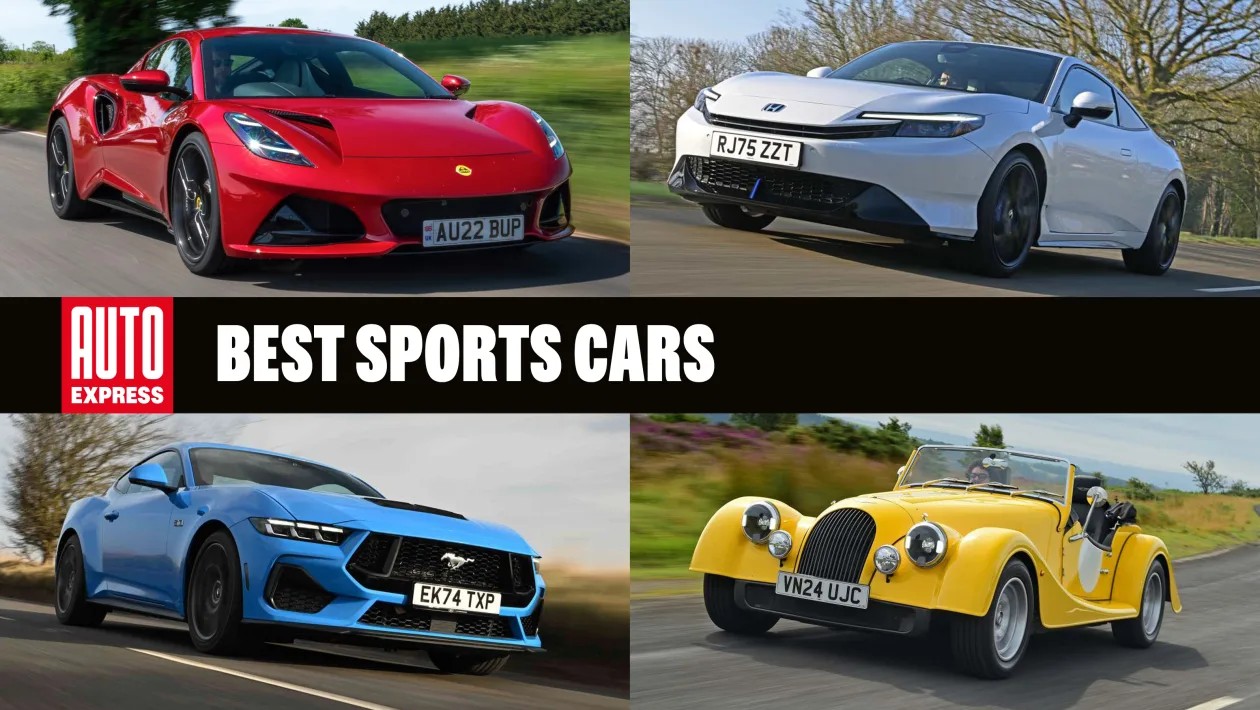
| 9 | Lotus Emira | £79,500 |
| 10 | Morgan Plus Four | £76,000 |
1. BMW M2: The Compact Performance Benchmark
Price: From £72,000
Award: Auto Express Coupe of the Year 2025
The BMW M2 occupies a unique niche in the automotive world. It is one of the few remaining two-door, four-seat, rear-wheel-drive coupes powered by a naturally aspirated-feeling straight-six engine. For buyers seeking a compact sports car that does not compromise on daily usability, the M2 is the standout choice.
Performance and Dynamics
At the heart of the M2 is a 3.0-litre twin-turbocharged six-cylinder engine producing 473bhp and 600Nm of torque. While the latest generation has gained weight (1,705kg), the chassis tuning remains exceptional. The car offers incredible sharpness and balance, making it more engaging than its larger M3 and M4 siblings. A higher-performance M2 CS variant is also available, boosting output to 530bhp, though it commands a premium of over £92,000.
Practicality and Ownership
Despite its performance credentials, the M2 is surprisingly practical. It features a 390-litre boot and three-way split folding rear seats. On a motorway cruise, it can achieve more than 30mpg, balancing thrill with efficiency. However, buyers should be cautious with the configurator; optional extras like ‘Individual paint’ can add over £4,000 to the bill.
Verdict
“I drove an M2 to Le Mans and back, and it actually proved to be a dependable long-distance cruiser. There’s plenty of room for two, and the boot was big enough to store a two-man tent plus a decent amount of luggage.” — Dean Gibson, Senior Test Editor
Pros:
– Fabulous turbocharged straight-six engine
– Impressive high-speed cruising ability
– True muscle car character when needed
Cons:
– Steering precision could be sharper
– Offset driving position may cause discomfort for some
– Ride quality is slightly fidgety at all speeds
2. Porsche 911: The Ultimate All-Rounder
Price: From £104,000
With a history spanning over 60 years, the Porsche 911 remains the gold standard for sports cars. The current 992 generation is arguably the most complete iteration to date, blending supercar performance with grand tourer comfort.
Performance and Versatility
The 911’s breadth of ability is its greatest strength. The entry-level Carrera achieves 0-62mph in 4.1 seconds, while the savage 641bhp Turbo S sprints to 62mph in just 2.7 seconds with a top speed of 205mph. Despite its power, the 911 is remarkably easy to drive, offering superb driver engagement and a high-quality cabin that makes it suitable for daily use.
Market Context
The 911’s rivals depend heavily on the specific variant. The BMW M4 competes with the entry-level Carrera but is roughly £10,000 cheaper. Higher up the range, the 911 competes with thoroughbred supercars like the Aston Martin Vantage and Maserati MC20.
Verdict
“All 911s have such high thresholds of grip that you have to be driving at quite some speed to unsettle them. In wet or cold weather, the 911’s inherent balance is more tangible…” — Jordan Katsianis, News Editor
Pros:
– Outstanding performance across the range
– High-quality, usable cabin
– Superb driver engagement
Cons:
– Turbocharged engines lack some emotional sound
– Expensive, especially with options
– Has lost its compact footprint over generations
3. Mazda MX-5: The Pure Driver’s Car
Price: From £28,600
The Mazda MX-5 is the world’s best-selling roadster, and its success is rooted in its commitment to lightweight, rear-wheel-drive driving dynamics. It is one of the few affordable, fun-to-drive sports cars still in production.
Driving Experience
The MX-5 prioritizes handling and enjoyment over outright speed. Available with 1.5-litre or 2.0-litre engines, it requires driver input to extract its best performance. The manual gearbox is among the best in its class, and the steering provides direct, rich feedback. While the seats are supportive, the cabin is snug, which may be challenging for taller drivers.
Value Proposition
At under £30,000, the MX-5 is significantly cheaper than rivals like the BMW Z4 or Porsche Boxster, which are only accessible on the used market. It competes not with other sports cars, but with front-wheel-drive hot hatchbacks, offering a level of involvement that those cars cannot match.
Verdict
“Back-to-basics driving thrills are what the Mazda MX-5 has always been about – and the latest version doesn’t disappoint. It’s a driver’s car that deserves to be mentioned in the same breath as much more expensive performance cars.” — Alex Ingram, Contributor
Pros:
– Ergonomic, driver-focused interior
– Lightweight, agile handling
– Good fuel efficiency
Cons:
– Modest straight-line performance
– Noisy Retractable Fastback (RF) version
– Low-speed comfort is firm
4. Honda Prelude: The Hybrid Coupe
Price: From £41,595
The Honda Prelude stands out as the only full-hybrid coupe on sale. It offers a unique blend of agile handling, efficient propulsion, and a stylish swooping design.
Performance and Handling
Powered by a 2.0-litre 181bhp hybrid engine mated to a CVT gearbox, the Prelude reaches 0-62mph in 8.2 seconds. While it is not a drag-racing contender, the acceleration feels lively and well-resolved. The chassis benefits from components shared with the Honda Civic Type R, including sharp steering and high-performance brakes, resulting in a neutral balance and high cornering confidence.
Interior and Practicality
The cabin is smart and sturdily built, with a good mix of physical and touchscreen controls. However, the rear seats are largely tokenistic, designed to fill space rather than offer genuine versatility, though they do fold to increase boot capacity.
Verdict
“The Honda’s back seats really seem like they’ve been designed to fill a space rather than offer any kind of multi-seat versatility. They do fold to boost practicality, though.” — Dean Gibson, Senior Test Editor
Pros:
– Agile chassis with good handling
– Well-resolved hybrid setup
– Impressive overall efficiency
Cons:
– Not particularly fast off the line
– Rear seats are of limited use
– Noticeable tyre noise on motorways
5. Ford Mustang: The V8 Muscle Icon
Price: From £58,670
For those who crave the raw, throbbing soundtrack of a V8 engine, the Ford Mustang remains unmatched. Despite being a large, heavy car, the latest generation has improved significantly in terms of chassis dynamics.
Performance and Character
The Mustang is a full-fat V8 muscle car at heart. While it is more capable in corners than its ancestors, it still prioritizes straight-line power and analogue driving feel. The six-speed manual gearbox is highly recommended for enthusiasts. A convertible variant is available, but the hard-top version offers better structural rigidity and driving dynamics.
Efficiency and Rivals
Old-school V8 power comes at an environmental cost. Expect around 20mpg and CO2 emissions of 274g/km. There are no direct rivals with a V8 engine; competitors like the BMW M2 offer more refined handling but at a higher price, while the Alpine A110 takes a completely different, lightweight approach.
Verdict
“For all its ability as a driver’s car, the Mustang’s credentials as a long-distance cruiser manage to exceed even those high standards – this is a model that really lives up to its GT billing.” — Alex Ingram, Contributor
Pros:
– Wonderful V8 engine soundtrack
– Poised chassis dynamics for its size
– Good comfort and refinement
Cons:
– Automatic gearbox is clunky
– Cabin design is dated
– Infotainment system is unintuitive
6. Porsche 718 Cayman: The Purist’s Choice
Price: From £53,800
The Porsche 718 Cayman is the brand’s entry-level coupe, but it should not be overlooked. Even as its successor approaches, the outgoing model remains a benchmark for mid-engined sports cars.
Performance and Balance
Most 718 variants use a four-cylinder engine (296bhp to 345bhp), which is effective but less emotive than the six-cylinder GTS variant (400bhp). However, the mid-engine layout provides superb traction and balance. The steering is beautiful, grip is immense, and the ride is brilliantly damped, making it one of the best sports cars from a pure driver’s perspective.
Market Position
The Cayman is more expensive than rivals like the Alpine A110 or Lotus Emira, but Porsche’s engineering expertise justifies the premium. It is a more refined and versatile option than its sharper, more raw competitors.
Verdict
*”The Porsche 718 Cayman is a