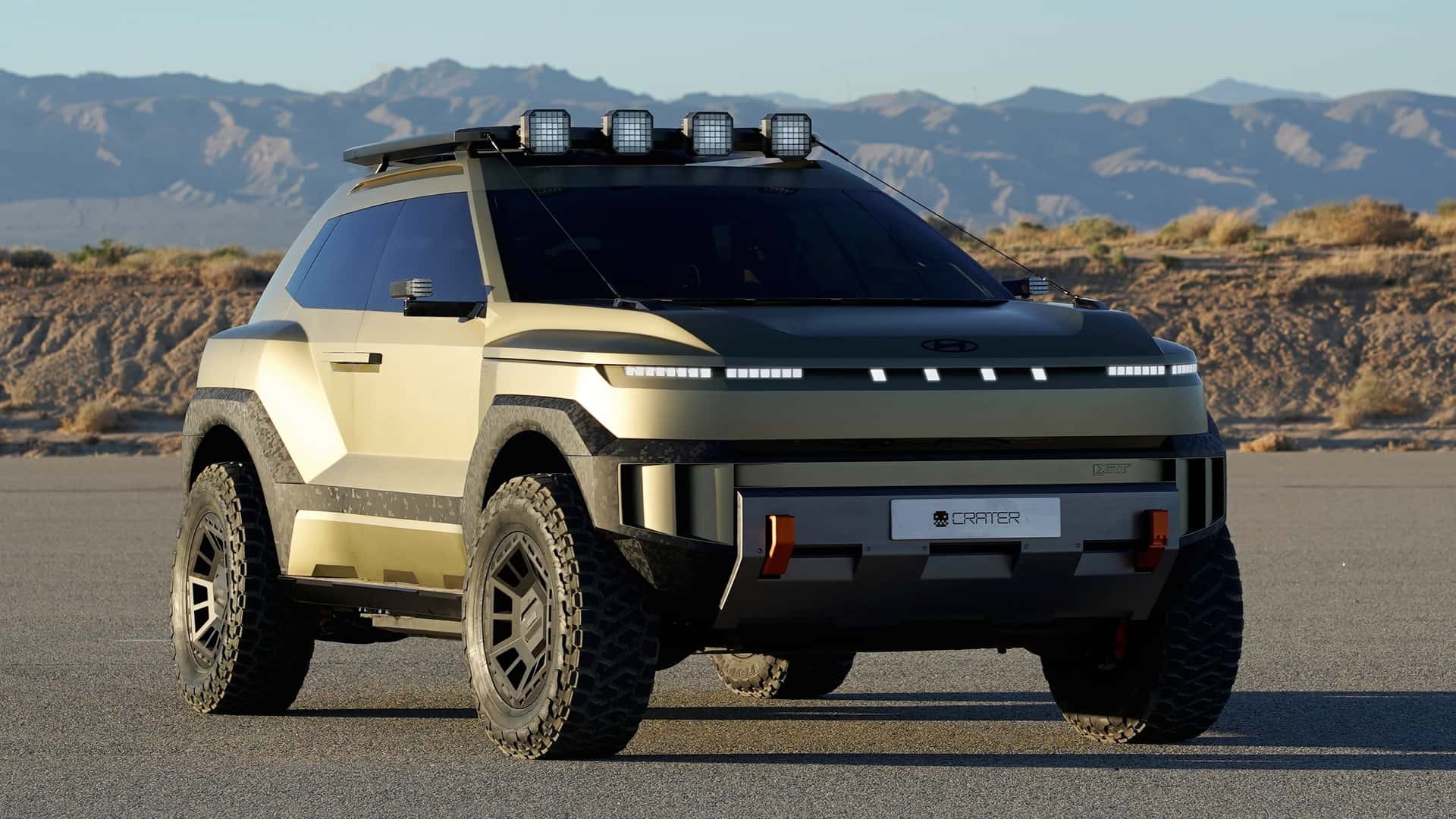
Hyundai has unveiled the Crater, an aggressive SUV concept that signals the brand’s ambition to compete seriously in the off-road vehicle segment. While currently just a design study, the Crater demonstrates how Hyundai envisions a rugged, all-electric future beyond its existing XRT line of mildly enhanced models.
Radical Design and Unique Details
The Crater stands out with its bold aesthetic: 33-inch off-road tires, heavy-duty skid plates, tow hooks, and multiple auxiliary lights create an imposing presence. Even the digital pixel camouflage—borrowed from the Ioniq 5 XRT—feels more purposeful here.
A playful touch is the “Crater Man” character, hidden throughout the vehicle as a design motif, appearing on recovery hooks, seat buckles, and the dashboard. This suggests Hyundai is willing to inject personality into its off-road offerings.
A Futuristic Interior
Inside, the Crater abandons traditional dashboard layouts. Instead, a cylindrical structure is suspended by straps, housing four removable square screens for functions like Spotify. The cabin is bathed in a warm rust-orange glow, and every touchpoint is wrapped in soft, curved upholstery—a new interior technique Hyundai calls “Curve of Upholstery”—eliminating hard plastics entirely.
Electric Power with Off-Road Intent
Hyundai has not released full specifications, but the Crater is confirmed to be electric. Speculation suggests it could leverage the Ioniq 5’s 84.0-kWh battery and dual-motor setup (320 horsepower, 446 lb-ft of torque). More importantly, the concept includes visible controls for low-range gearing and locking differentials, hinting at genuine off-road capability for a battery-powered SUV.
What This Means
The Crater won’t be sold as-is. Instead, it serves as a preview of where Hyundai’s XRT models might evolve. The current XRT lineup (Ioniq 5, Palisade, Santa Fe) adds rugged styling, but the Crater demonstrates a commitment to true off-road performance.
The Crater concept is a clear message: Hyundai is serious about off-roading and is willing to push boundaries with its electric vehicle designs.
If Hyundai incorporates even a fraction of the Crater’s DNA into future production models, the brand could become a credible competitor in the segment currently dominated by Ford and Jeep.