Toyota’s Gazoo Racing division isn’t waiting for the curtain to rise.
Before the halo GR GT even hits dealership showrooms, prototypes of two wilder variants are already tearing up the Nürburgring. It’s a familiar playbook. Mercedes did it with the GT 63 and its many permutations. Toyota is doing the same here. The message is clear: the base car is just the start.
The latest spy shots reveal these machines in their natural habitat—the Green Hell. It’s punishing. It’s unforgiving. And it’s where Toyota sends its test mules to be broken in before we ever see them.
The “Slightly Faster” GR GT Prototype
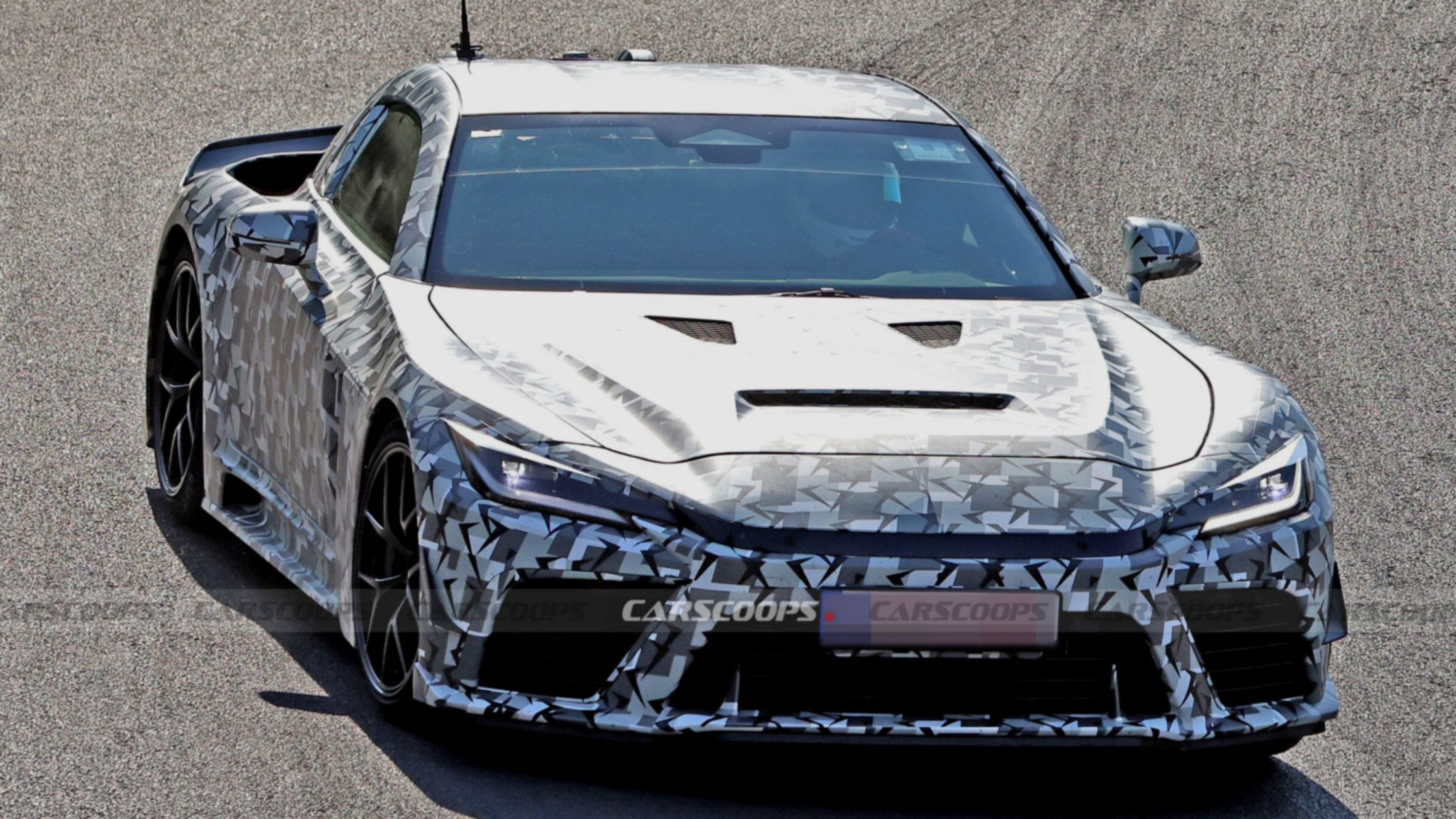
One prototype arrives cloaked in the usual heavy camouflage. At first glance, it mirrors the production car unveiled last December. Same silhouette. Same aggressive stance.
But look closer.
Small tweaks betray a more focused intent. At the front bumper’s outer edges, you’ll spot aerodynamic canards. They’re subtle. They add a bit of downforce. Not groundbreaking stuff, but it helps.
The rear tells a different story. The standard GR GT features a body-colored lip spoiler. This one exposes carbon fiber instead. Is it bigger? No. It looks roughly the same size.
So why change the material? Weight savings? Aesthetic signaling? Probably both.
If this is indeed the higher-performance spec—or an optional upgrade pack—don’t expect massive external changes. The real work happens under the skin. We’re talking about:
– Newly tuned suspension geometry
– Stiffer braking components
– Likely revised engine mapping via software
It’s the kind of refinement that makes a car feel sharper without looking radically different.
The Track-Only Monster
Then there’s the second car.
The real showstopper. This prototype looks like Toyota’s answer to the 911 GT3RS. Well, if you ignore the sheer scale. The GR GT is larger. Heavier. Therefore, a more accurate comparison might be the Mercedes-AMG GT Black Series. Though perhaps not quite as extreme in its madness.
The aerodynamics here are serious business.
1. A pronounced splitter at the front.
2. Four aggressive canards flanking the bumper.
3. New front quarter panels featuring adjustable louvers for brake cooling management.
Rearward, a towering swan-neck wing dominates the view. It’s huge. It looks like it belongs on an LMP1 prototype, not a street-legal supercar.
Surprisingly, the rear bumper and diffuser remain unchanged. Maybe Toyota is saving the heavy aerodynamic work for the front. Or maybe they’re confident in the base airflow.
Power, Weight, and the V8 Heart
Under the hood sits Toyota’s prized 4.0-liter twin-turcharged V8. In the standard GR GT, it pumps out over 641 hp. Torque figures hit 627 lb-ft (that’s 850 Nm for our metric readers).
For the track-focused version, expect more.
Engineers rarely bolt on big aero wings without increasing power to utilize the downforce. We’re likely looking at numbers edging closer to 700 hp. That’s a significant jump. It turns “fast” into “dangerous” very quickly.
Handling will be bolstered by upgraded chassis components. Stiffer springs. Dampers tuned for maximum grip. But there’s another variable. Weight.
The standard GR GT is expected to tip the scales at around 3,858 lbs 1,750 kg. That’s heavy for a mid-engine V8 coupe. The track version will likely shed some mass. Carbon fiber bits? Removed. Sound deadening? Scraped out. Every kilogram saved improves the power-to-weight ratio. And on a tight circuit like the Nürburgring, that’s everything.
What Happens Next?
Toyota is moving fast. The Nürburgring tests suggest these variants aren’t pipe dreams. They’re in the pipeline.
Will Toyota follow the Mercedes path of releasing a GT 3, a GT RS, and a Black Series? The current testing hints at a tiered approach. A refined street version. An extreme track weapon.
The question isn’t really if Toyota will offer these variants. The evidence is on the track. The question is: when will they make it to the public?
And will we actually be able to afford them when they do?
“Toyota will follow a similar path as Mercedes-AGS with its GT 63 and several different versions.”
One thing is certain. The standard GR GT might soon feel like the entry-level model. Not in price, but in capability.