


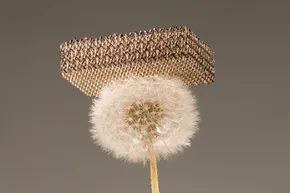
Microlattice. It sounds like an artisanal ice cream flavor or a tech startup that will disappear in six months. But look at the viral image. A tiny cube on top of the dandelion seeds. It does not destroy the flowers. It barely registers.
This is the hook. The reality is colder and harsher, but also more useful.
Each wire of this material is laser cut from nickel. These filaments are thinner than human hair. Combining these results in a structure that is 99.99% air. Think of it like an empty styrofoam cup. Now imagine picking up that cup and then picking up a cup made of microlattice metal. Metal is light. It goes against all your instincts about what metal should feel like.
How Laser Cutting Changes Everything
This is not magic. This is a precision engineering collaboration between University of California-Irvine, Caltech and HRL Laboratories. The Department of Defense’s research and development arm, DARPA, funded the original research because it needed a material that could withstand impacts and bounce back.
The result is a grid whose volume can be halved. You squeeze it. I came right back. No permanent deformation. No crumpling.
“Even if you squeeze the volume to half, it immediately returns to its original shape.”
This flexibility is key. Most metals yield. They bend permanently. This is not the case with the microlattice. Works like a superspring. This feature alone is changing the conversation about vehicle safety and efficiency.
Why this matters for the automotive industry
The current car design is a compromise. Lighter weight is necessary to save fuel. Requires heavier structural rigidity and crash protection. You can’t have it both ways. Not really.
A microlattice breaks this rule. A car body made of this material are lighter than design made of plastic foam of the same model. However, it can absorb shocks and return to its original shape.
Let’s think about physics. A lighter car means less air resistance. Less air resistance means better fuel efficiency. But the safety angle is just as attractive. If a car can absorb crash energy without crumpling, it can better protect its occupants. But what about everyday drivers? Parking lot door dings is not only annoying. They’d be irrelevant. The dent will pop out automatically.
Where else does this apply?
DARPA is also looking for uses beyond parking. This material’s ability to absorb acoustic, shock and vibration energy makes it ideal for aerospace damping. Think of the quiet cabin of a jet or airplane.
Energy harvesting systems also have potential. Captures unnecessary vibration and converts it into power. Or make better batteries. This construction provides a frame that can contain more energy without adding weight.
This is all still in the experimental stage. The manufacturing process is complex. Scaling it up to mass-produce was a big mountain to climb. But The physics work. The material exists.
One day, if you look back at today’s crumple zones, as crude. You can even park your car on a dandelion and laugh. Until then, the dream of a lightweight vehicle with self-healing capabilities is closer than ever. Don’t expect to see it in your dealership tomorrow.


