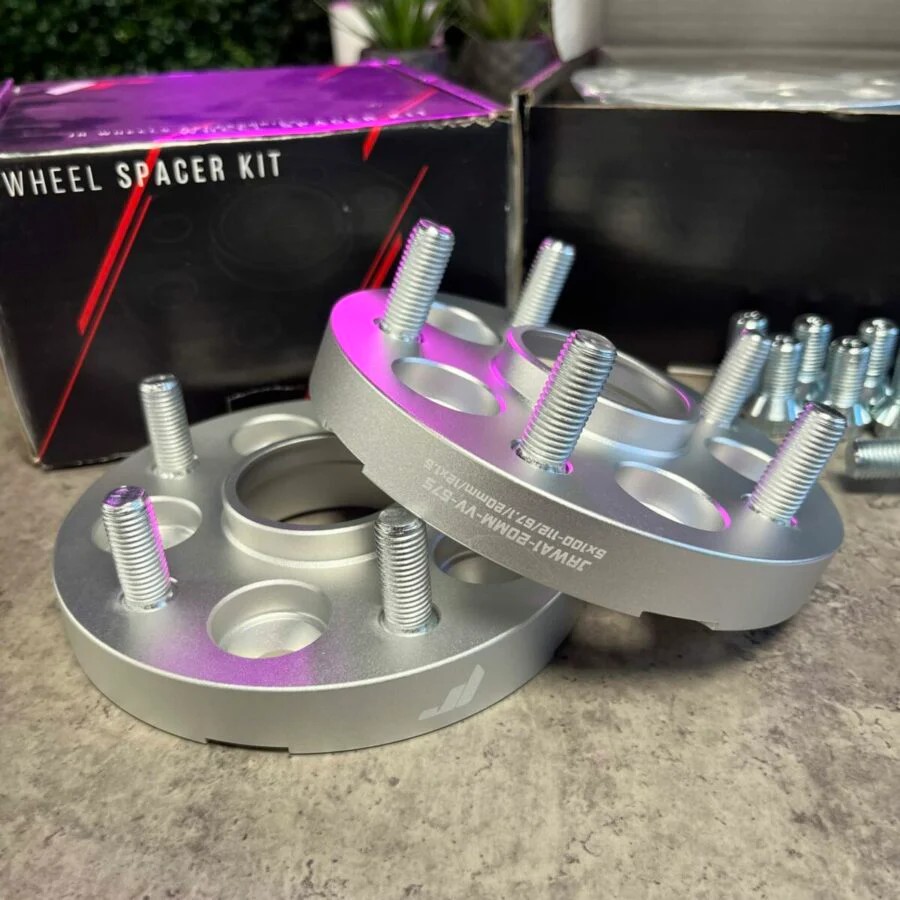
Most car enthusiasts start with wheel spacers, a simple fix for minor stance adjustments or suspension clearance. But when dealing with mismatched wheels and custom builds, spacers alone are insufficient. The core problem isn’t positioning—it’s fundamental incompatibility between the wheel and the vehicle’s mounting surface.
The Limitations of Spacers
Spacers effectively move the wheel outward but don’t address underlying fitment issues. They cannot correct:
- Bolt pattern (PCD) mismatches: Different vehicles use different bolt hole arrangements.
- Centre bore differences: Wheels and hubs can have incompatible center hole sizes.
- Stud/bolt compatibility: Some wheels require studs instead of bolts, or vice versa.
- Clearance issues with long studs: Extended studs can interfere with adapters if they’re too thin.
If a wheel is already compatible, spacers work fine. If not, a more comprehensive solution is required.
The Fitment Geometry Problem
Wheel fitment isn’t just about size; it’s about aligning three critical interfaces: the hub, the mounting face, and the wheel itself. Each has fixed dimensions that must align for secure mounting. When they don’t, standard spacers won’t solve the problem. The proper solution is a PCD hub adapter, which creates a new mounting interface between the car and the wheel.
How PCD Hub Adapters Work
Hub adapters sit between the car and the wheel, allowing you to:
- Convert between different PCDs.
- Match centre bore dimensions.
- Change from bolt to stud setups (or vice versa).
Unlike spacers, these adapters address the underlying fitment issue, making them essential for cross-brand wheels and custom builds.
The Challenges of PCD Overlap
Generic advice often fails when PCD conversions become complex. Some combinations result in bolt holes that physically clash, leading to structurally weak adapters. Attempting to machine two incompatible patterns into a single piece can create insufficient material between fasteners, compromising the adapter’s integrity.
Two-Piece Adapters: The Necessary Solution
When bolt patterns overlap, the only safe solution is a two-piece design: an inner section mounting to the hub and an outer section carrying the wheel bolt pattern. This eliminates hole overlap, maintains material strength, and ensures proper clamping force. From an engineering perspective, this is not an upgrade; it’s a necessity when the geometry demands it.
Real-World Example: Audi Wheels on BMW Hubs
Trying to fit Audi wheels (5×112) onto a BMW hub (5×120) illustrates this problem. The bolt holes for these patterns can sit too close together to safely machine into a single adapter. A two-piece adapter separates the patterns, preserving structural integrity and proper load distribution.
The Overlooked Issue: Stud Length
Another critical factor is stud length. If wheel studs protrude significantly past the hub face (25–40mm), a thinner adapter will cause the studs to bottom out, preventing a flush fit and uneven load distribution. Solutions include increasing adapter thickness or modifying the studs. This is why off-the-shelf parts often fail in complex setups.
The Need for Custom Adapters
Combining PCD mismatches, centre bore differences, stud protrusion, and required adapter thickness leads to highly specific constraints. Universal solutions don’t exist. Every dimension affects the design, making custom adapters necessary for overlapping bolt patterns or unusual fitment requirements.
“Fits” vs. “Works Properly”
A setup can physically bolt together but still be wrong. Proper fitment requires:
- Flat mounting surfaces
- Correct clamping force
- Proper thread engagement
- Even load distribution
Compromising any of these results in a flawed solution that only appears to fit. In wheel fitment, this distinction is critical for safety and performance.