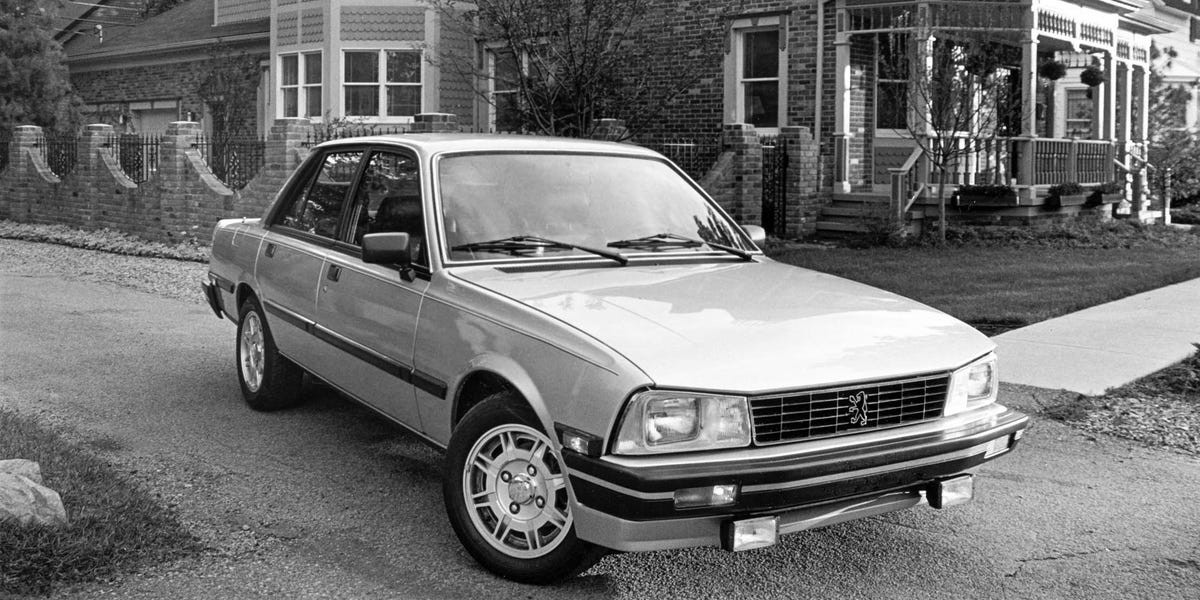
In the mid-1980s, the luxury sedan market was undergoing a shift. While many drivers were gravitating toward flashy, high-performance models, a growing class of “upwardly mobile” professionals sought something different: a vehicle that offered rapid transit without sacrificing dignity. The Peugeot 505 Turbo enters this arena, positioning itself alongside established European heavyweights like Volvo, Audi, and Saab.
This is not a car for the adolescent dreamer or the driver looking to make a loud statement at a drive-in. Instead, the 505 Turbo is a refined, secure cruiser designed for adults who value competence and understated elegance.
A Transformation Beyond Just Power
Adding a turbocharger to a vehicle is often just a way to make a standard model go faster. However, Peugeot has treated the 505 Turbo as a holistic upgrade. The “Turbo” designation brings a suite of subtle but significant refinements that transform the driving experience:
- Improved Stance: The car sits approximately 1.4 inches lower than the standard 505 STI.
- Enhanced Grip: It features new 15-inch eight-spoke alloy wheels wrapped in high-performance Michelin MXV tires.
- Refined Aerodynamics: New spoilers have reduced the drag coefficient from 0.42 to 0.39, aiding both efficiency and stability.
- Upgraded Hardware: The package includes ventilated front disc brakes for better fade resistance and a limited-slip differential as standard.
The Heart of the Machine: The N9T Engine
At the center of this transformation is the N9T engine, a 2.2-liter four-cylinder powerhouse with deep technical roots. Originally part of a lineage involving French Chrysler and Talbot, this engine was reportedly developed under contract by Porsche.
While European racing versions of this engine produce staggering horsepower, the U.S. specification is tuned for reliability and drivability. It delivers 142 horsepower at 5,600 rpm and 163 lb-ft of torque at 3,800 rpm—a massive leap of 46% in power over the standard STI model.
The engine’s sophistication lies in its digital management:
1. Bosch LU-Jetronic Fuel Injection: A digital system that utilizes oxygen and knock sensors to maintain an optimal mix.
2. Cartographic Ignition: An advanced electronic system that references a memory bank of 1,768 specific ignition-advance points, adjusting timing up to 187 times per second.
3. Garrett TBO3 Turbocharger: Provides up to 8.3 pounds of boost to ensure the engine breathes efficiently under load.
Driving Dynamics: A Matter of Technique
The 505 Turbo is not a “muscle car” that rewards aggressive, heavy-handed inputs. It is a precision instrument that requires a certain level of finesse.
The four-speed manual transmission is well-staged, though the hydraulic clutch feels somewhat over-assisted and lacks a heavy, mechanical “feel.” The driving experience is best described as a partnership: if the driver uses smooth, measured inputs—coasting into corners and maintaining long, sweeping arcs—the car rewards them with a memorable, high-quality ride.
The suspension, featuring Peugeot’s signature hydraulic shocks, is perhaps the car’s greatest strength. Drawing on Peugeot’s expertise in endurance rallying across Africa, these shocks handle irregular pavement with remarkable composure, absorbing bumps without sacrificing stability or inducing harshness.
Interior Comfort and Standard Luxury
Inside, the 505 Turbo prioritizes the “human element.” The cabin is characterized by:
* Exceptional Seating: The seats offer a level of orthopedic and lateral support that rivals more aggressive German competitors, making them ideal for long-distance touring.
* High Visibility: Large glass areas and thin pillars provide a sense of openness.
* Comprehensive Standard Equipment: Unlike many American luxury offerings of the era that charged extra for every feature, the Peugeot comes standard with a power sunroof, air conditioning, cruise control, central locking, and heated electric mirrors.
While the cabin is exceptionally quiet and well-insulated, it is not perfect; wind noise around the A-pillars remains a noticeable trait shared with other 505 models.
Conclusion
The Peugeot 505 Turbo is a masterclass in “subtle transformation.” By integrating high-tech engine management with a sophisticated, rally-tested suspension, Peugeot has created a vehicle that serves as a rapid, comfortable, and dignified transit system for the discerning driver.
Final Thought: The 505 Turbo is a car that rewards intelligence over aggression, offering a refined European driving experience that prioritizes poise and long-distance comfort.