In the early 1990s, Subaru was a brand defined by its eccentricities. From the pinball-machine-like Subaru XT to the quirky Justy, the manufacturer wasn’t afraid to be “weird.” However, no vehicle in their history captured the imagination—or the confusion—quite like the Subaru SVX.
Designed as a high-tech grand tourer, the SVX was an attempt to prove that Subaru could master luxury and performance just as effectively as they mastered rugged practicality. While it ultimately failed to find a mass market, it remains one of the most distinctive automotive experiments of its era.
Design: The “Batmobile” Aesthetic
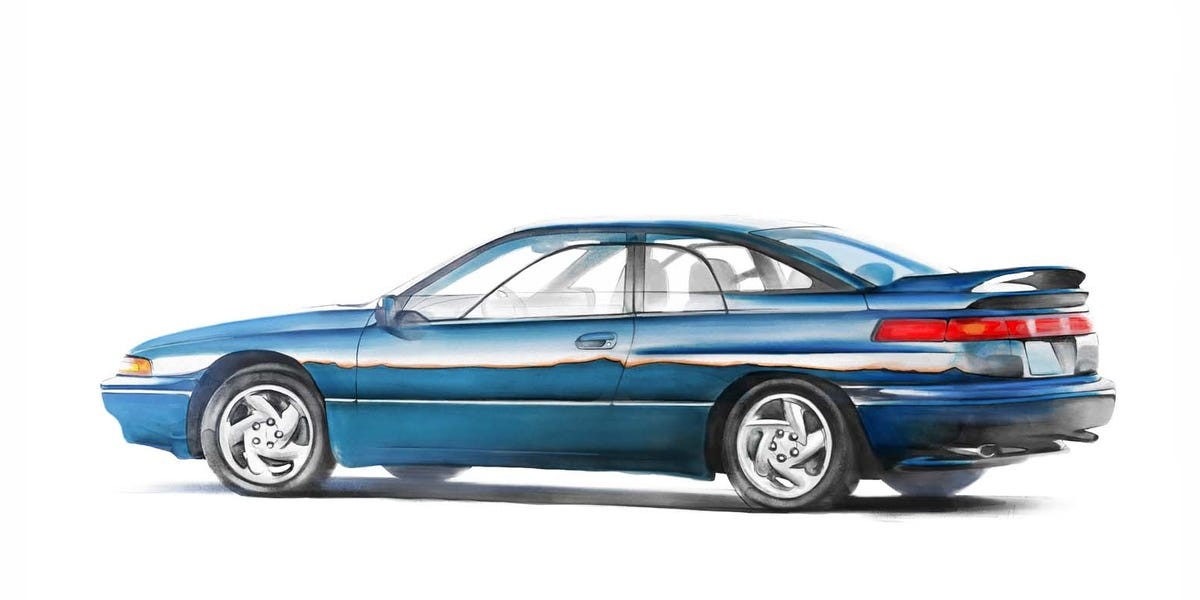
The SVX’s most striking feature was its silhouette, shaped by the legendary Italdesign of Giugiaro. The car featured a “canopy” style greenhouse with windows that curved voluptuously into the roof, creating a conservatory-like interior.
To make this radical design work, engineers had to solve a practical problem: the long, shallow doors couldn’t accommodate large single panes of glass. The solution was a unique window-within-a-window system. A large, static pane provided the sleek look, while a smaller, movable pane allowed for ventilation and airflow. While onlookers often compared the car to the “Batmobile,” the design provided a bright, joyful driving environment that felt more like a high-end cockpit than a standard coupe.
Performance: A Sophisticated Grand Tourer
Underneath its unconventional skin, the SVX was a serious machine. It was powered by a 3.3-liter flat-six engine producing 230 horsepower—a sophisticated precursor to the engines Subaru would refine in the decades to follow.
Key performance characteristics included:
-
Refined Handling: The SVX offered a driving experience comparable to the Lexus SC or Toyota Supra,, balancing comfort with substantial road presence.
-
Advanced Transmission: The 4EAT transmission featured an intelligent clutch pack capable of sophisticated torque distribution.
- Highway Dominance: The car was engineered for the interstate. At 80 mph, the engine sat at a relaxed 2,700 rpm, making it an ideal long-distance cruiser.
- Build Quality: Even under rigorous long-term testing, the chassis remained remarkably quiet and rattle-free, possessing a structural solidity reminiscent of a submarine hull.
The Market Paradox: Why It Failed
Despite its technical merits and striking looks, the SVX never achieved the commercial success Subaru envisioned. The company hoped for annual sales of 10,000 units, but reality fell short:
– 1992 Sales: 3,667 units
– 1993 Sales: 3,859 units
The SVX occupied a difficult niche. It was too “weird” for traditional luxury buyers and perhaps too specialized for those looking for a standard sports coupe. It was a “Hail Mary” pass from a team of engineers and designers who wanted to push the boundaries of what a Subaru could be.
Conclusion
The Subaru SVX remains a fascinating “what if” in automotive history—a high-quality, beautifully designed grand tourer that proved Subaru had the talent to compete in the luxury segment, even if the market wasn’t quite ready for its radical vision.