In the 1980s, Toyota made a decision that many industry analysts deemed impossible: they set out to dethrone the German giants—BMW and Mercedes-Benz—in the high-end luxury market. To win, Toyota didn’t just need to be competitive; they needed to dominate in three critical pillars: power, refinement, and reliability.
What followed was one of the most ambitious engineering undertakings in automotive history, resulting in an engine family so robust that it became a legend among enthusiasts and mechanics alike.
Project F1: Engineering Without Limits
The catalyst for this revolution was a mandate from Toyota’s Chairman, Eiji Toyoda: build the best engine ever made. To achieve this, the company launched “Project F1” (where the ‘F’ stood for Flagship).
Unlike modern automotive development, which is often constrained by strict quarterly budgets and cost-cutting measures, Project F1 was a “blank check” program. Chief Engineer Ichiro Suzuki was given total creative freedom. The goal was simple but daunting: outclass every luxury engine on the planet in every measurable category.
The scale of this effort was unprecedented:
– 900 different engine iterations were developed.
– 1.67 million test miles were driven to ensure durability.
– Racing DNA: It is now understood that the team used a CART/IndyCar V8 as their primary engineering reference.
The Masterpiece: The 1UZ-FE
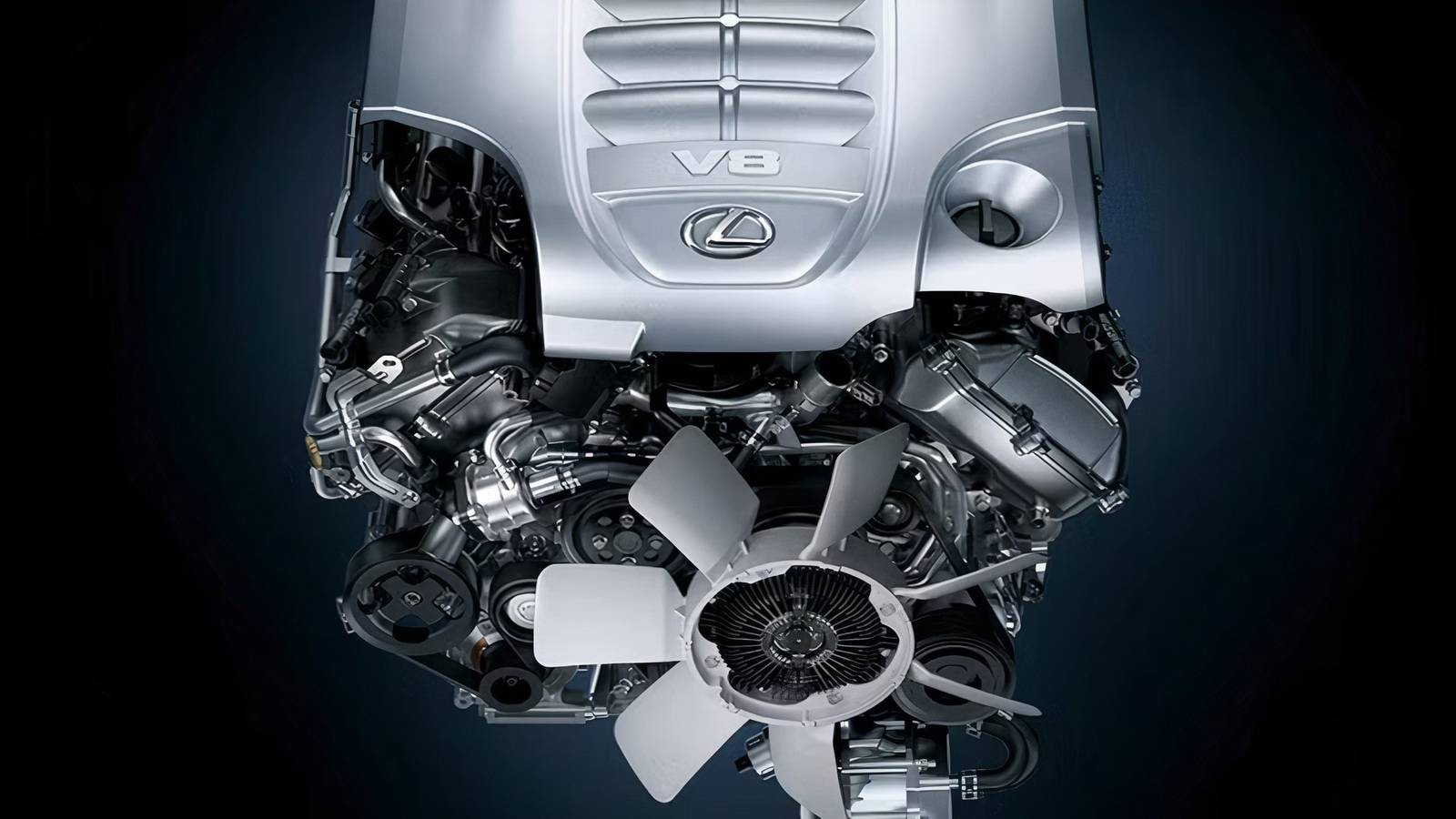
The result of this relentless pursuit was the 1UZ-FE V8. This wasn’t just a passenger car engine; it was a racing engine disguised as a luxury powerplant.
Toyota utilized “overengineering” as a core philosophy. While most V8s of the era used four-bolt main bearing caps, the 1UZ-FE used six-bolt cross-bolted caps to ensure maximum structural rigidity. The engine featured an all-aluminum construction for lightness and an “oversquare” design (larger bore than stroke) to allow for massive airflow and high-RPM performance.
The “Champagne Pyramid” Test
Toyota’s marketing team famously demonstrated the engine’s legendary smoothness through a single, iconic advertisement. They placed a pyramid of 15 champagne glasses on the engine bay of a car on a dynamometer. As the car accelerated past 140 mph, the glasses remained perfectly still. This feat proved that Toyota had achieved a level of refinement that made even the best German luxury cars feel unrefined by comparison.
Two Philosophies, One Goal: The UZ Family
While the 1UZ-FE conquered the luxury sedan market, Toyota recognized that different vehicles required different strengths. This led to the creation of the 2UZ-FE, a sibling that took a completely different engineering path.
| Feature | 1UZ-FE (Luxury Focus) | 2UZ-FE (Utility Focus) |
|---|---|---|
| Block Material | All-Aluminum | Cast-Iron |
| Design Ratio | Oversquare (High RPM/Power) | Undersquare (Low-end Torque) |
| Primary Use | Luxury Sedans (Lexus LS) | Trucks & SUVs (Tundra, Land Cruiser) |
| Core Strength | Extreme Refinement | Extreme Durability & Towing |
The 2UZ-FE was built for the “trial by fire.” Designed for heavy-duty towing and off-road environments, the cast-iron block provided the heat resistance and rigidity necessary to survive environments that would destroy a standard aluminum engine. This version was so robust that Toyota Racing Development (TRD) even offered factory supercharger kits, capable of pushing the engine toward 400 hp without sacrificing its legendary reliability.
A Lasting Legacy: From Luxury to Legend
Although the UZ family ended production in 2013, its influence persists in the automotive community through two distinct avenues:
- The Enthusiast Swap: As the legendary 2JZ-GTE engine becomes increasingly expensive and rare, enthusiasts are turning to the 1UZ-FE. It offers a reliable, smooth, and highly tunable V8 platform at a fraction of the cost.
- The Overlanding Standard: In the off-road and overlanding communities, the 2UZ-FE remains a gold standard for reliability in remote, harsh environments.
“The UZ family was the physical embodiment of Lexus’s slogan: The Relentless Pursuit of Perfection. It represents a rare moment in history where engineering excellence was prioritized over financial constraints.”
Conclusion
The UZ engine family stands as a testament to what is possible when an automaker prioritizes long-term durability and absolute refinement over short-term profit margins. By mastering two different engineering philosophies, Toyota created a legacy of “unkillable” engines that continues to define automotive excellence decades later.