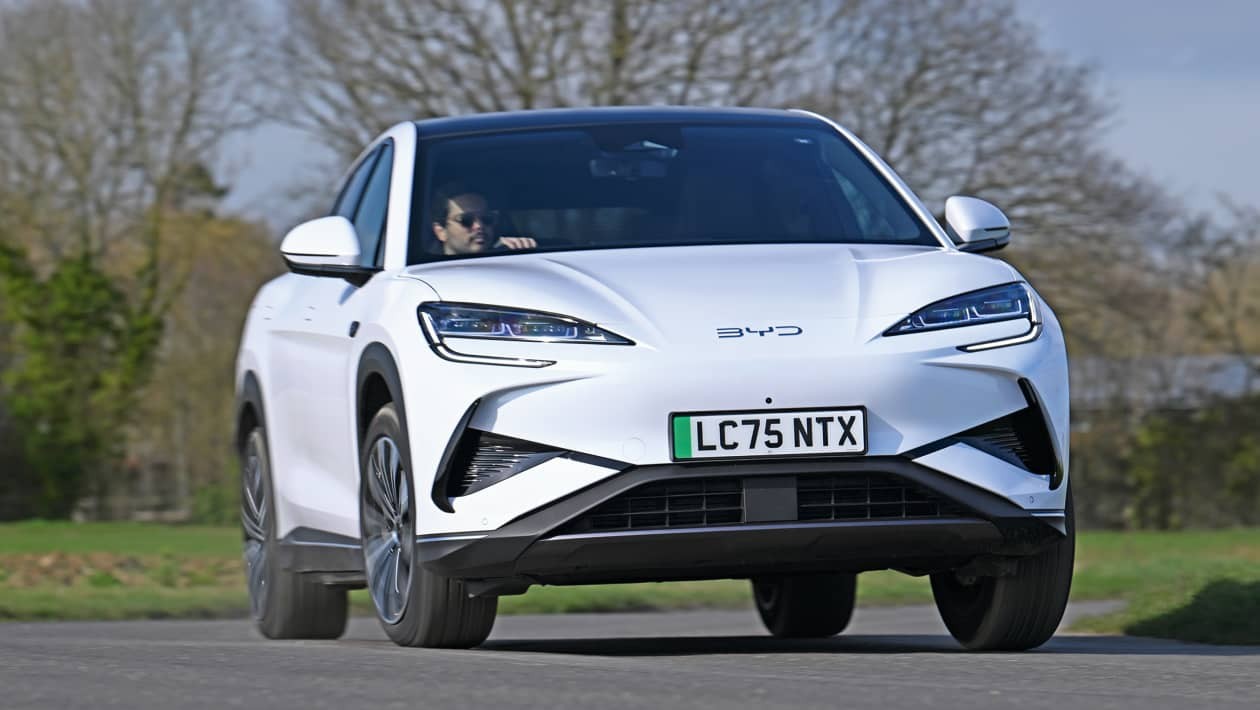
After 1,600 miles of testing, the verdict on the BYD Sealion 7 is a complex one. While BYD has successfully mastered the “product” aspect—offering a spacious, tech-heavy, and well-equipped SUV—it is struggling to deliver the “car” experience. For a vehicle priced at nearly £50,000, the driving dynamics and efficiency fall short of what legacy European rivals provide.
The Tech Paradox: High Features, Low Refinement
On paper, the Sealion 7 is an impressive feat of engineering. It enters the market with a “premium” mindset, boasting a massive 15.4-inch touchscreen, a panoramic roof, and a highly praised 360-degree camera system that makes navigating tight spaces effortless.
However, the user experience is inconsistent:
– Digital Complexity: While the screen is responsive and supports wireless Apple CarPlay, essential functions are often buried deep within sub-menus.
– The “Always On” Quirk: A peculiar software feature allows the car to be fully locked while still powered on. While useful for keeping the cabin warm during a quick errand, it carries a risk: leaving the car “on” while locked can drain up to 20% of the battery in just 10 hours as the climate control and electronics remain active.
– Missing Essentials: Despite its price tag, the car lacks features often expected in this segment, such as adaptive headlights, massaging seats, or autonomous parking assistance.
Driving Dynamics: A Disconnected Experience
The most significant criticisms emerge once the driver hits the road. The Sealion 7 suffers from a lack of cohesion between its various mechanical components, leading to a driving experience that feels unrefined.
1. Unpredictable Controls
The relationship between the driver and the car’s inputs feels mismatched. The throttle response is sluggish, making overtaking or pulling away from junctions a cautious affair. Conversely, the brakes are hyper-sensitive and “spongy,” making low-speed maneuvers like parking frustrating and jerky.
2. Suspension and Handling
The chassis setup appears unbalanced. The suspension is soft, yet it fails to provide a comfortable ride. Instead, it tends to roll heavily in corners while simultaneously transmitting road imperfections into the cabin. This results in a “befuddled” feeling where the body seems disconnected from the wheels, especially on uneven surfaces.
3. Stability and Noise
At motorway speeds, the car requires constant micro-corrections to stay centered in its lane. This instability, combined with noticeable wind noise and mechanical grumbling from the suspension, prevents the Sealion 7 from being a relaxing long-distance cruiser.
Efficiency and Value: The Bottom Line
For an electric vehicle, efficiency is the ultimate metric of value. Currently, the Sealion 7 is delivering roughly 2.8 to 2.9 mi/kWh in mixed driving, which drops to about 2.5 mi/kWh on the motorway.
This efficiency gap is critical:
– Range Anxiety: Real-world motorway driving may limit the range to just under 200 miles.
– Running Costs: At average UK charging rates, it is not significantly cheaper to run than a highly efficient petrol car.
– Market Competition: Rivals like the Volkswagen ID.5 offer better range, better performance, and a lower entry price, making the BYD’s value proposition difficult to justify.
The Takeaway: The BYD Sealion 7 is a masterclass in high-tech interior design and feature density, but it lacks the mechanical “soul” and refinement required to compete with established European brands.
Conclusion
The BYD Sealion 7 succeeds as a high-tech gadget on wheels, offering impressive visibility and luxury features, but fails to deliver a cohesive, refined driving experience. To truly compete in the premium SUV market, BYD must bridge the gap between impressive digital specs and fundamental driving dynamics.