


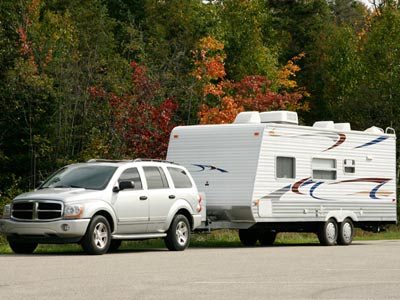
Nothing beats the escape of a family camping trip. You trade the cabin for fresh air, trade incompetent bosses for campfire cooking, and actually develop a bond with your children. There’s only one way to immediately break this idyllic image: get pulled over for ignoring trailer towing regulations.
It’s easy to get carried away. You want the largest and most baddest camper on the market. But states limit the length, width, and height of trailers for good reason. They also care about weight. Adding a trailer makes braking significantly more dangerous. If your trailer is too heavy, you need special brakes. You might not get a ticket for missing brakes until you crash, but then you’ll be in legal and financial trouble.
Planning is more than packing flashlights and hot dogs. You need to know the specific trailer towing guidelines for your home state and each state you drive through. If your trailer exceeds legal limits, you may need a special permit to cross certain borders.
Towing regulations can seem like a bureaucratic nightmare. But we simplify it. We break down the basics required by all states in the US and the stricter rules that apply in certain regions.
The absolute minimum for legal towing
When you cross state lines, your status as a law-abiding driver in one area does not automatically protect you in another. From Alabama to Mississippi, for example, it’s not just a change of scenery. It’s a rule change.
You may suddenly exceed the maximum towing speed, which drops by 10 mph (16 kph). Your trailer that was fine in Alabama may be too wide in Mississippi because the maximum width narrows by six inches (15 centimeters). Your weight limit can also drop 1,000 pounds, suddenly requiring trailer brakes.
Then there’s the problem of multiple trailers. Are you towing a camper and a jet ski behind it? You are fine in South Carolina. If you cross into Georgia, you are breaking the law.
To keep things simple, we’ll start with the equipment you’ll need anywhere in the United States.
- Taillights: Your trailer must have working taillights. It is a basic matter of road safety.
- License plate light: You need dedicated light so that the license plate is clearly visible at night.
Common Safety Requirements
Beyond the bare minimum, most states require equipment that are that is also just common sense. Ignoring this is a liability just waiting to happen.
- Safety chains: These cross in an X shape between the trailer and the towing vehicle. If the hitch fails, they prevent separation.
- Brake lights: Your trailer is opaque. Drivers behind you struggle to see around it. to prevent rear-end collisions, your trailer needs its own brake lights.
- Clearance lights: Generally only required if your trailer exceeds a certain width. These show other drivers the outline.
- Turn signals: If the trailer blocks your vehicle’s turn signals, you need separate turn signals for the trailer itself.
- Reflectors: These are important precautions to keep a large trailer visible in low light.
State-Specific Extras and equipment
Some states require additional equipment. You should check your local laws for these items.
- Breakaway brakes: Like safety chains, these prevent accidents if the trailer hitch breaks. These are power brakes that automatically apply to the trailer when it is uncoupled from the towing vehicle.
- Flares: Keep them handy to mark your vehicle and clear the road in the event of an accident.
- Tie-down Straps: If you’re loading something that can fall, you’ll need tie-down straps to secure it in multiple angles.
The physics of braking and speed
Improper braking is one of the biggest mistakes new towers make. It’s also the easiest to get wrong. The more weight you pull, the more momentum you create. That momentum means a longer stopping distance.
This is why most states require trailer brakes if your rig exceeds a certain weight limit. In some places, this limit is as low as 1,500 pounds (680 kilograms).
Braking is also more dangerous at higher speeds. As a result, all states require a maximum towing speed. This limit can be as low as 45 mph (72 kph). Speed kills, especially when you’re dragging a heavy box behind you.
Dimension Limits vary widely
As we’ve already seen, the dimensional requirements in trailer towing laws vary considerably from state to state. You cannot assume that one size fits all.
A trailer usually typically must be as narrow as 8 or 8 1/2 feet. The entire rig could be restricted, sometimes as low as 53 feet (16 meters). In some jurisdictions, the trailer itself cannot be longer than 35 feet (10.7 meters). Height is often limited to 12–14 feet (3.7–4.3 m).
If you ignore these dimensions, you aren’t just risking a ticket. You could get jackknife, crash, or get stuck under a bridge that your home state didn’t care about.
Insurance and liability
If an accident happens, you need insurance. The right coverage is the last piece of the puzzle. Next we talk about trailer insurance and how you can protect yourself if something goes wrong.


