


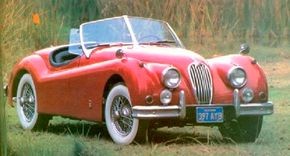
A sleek and fast Jaguar XK sports car, the XK-120, followed by the XK-140 and XK-150, is widely considered one of the most romantic machines ever built. they changed the game. But to understand why, we have to go back in time.
The London Motor Show was held at Earl’s Court in October 1948. The doors opened and car-hungry Brits practically surrounded the Jaguar stand. Why? The all-new Jaguar XK-120.
This is more than just a car. This is the coolest, sexiest and most modern sports car ever made in the UK. A smooth and powerful new six-cylinder twin-cam engine is combined with the curved, recessed fender. This was a complete departure from pre-war British design norms. However, enthusiasts consider this model to be a direct spiritual successor to the 1937 SS 100. It was a bold symbol of the post-war industrial revival. It appealed to both sides of the Atlantic.
In the US, the XK-120 serves a similar role to the MG TC. This sparked a sports car boom that led to the creation of domestic two-seaters such as the Chevrolet Corvette and the Ford Thunderbird. These cars are now highly sought after as collectibles. These set the stage for Jaguar’s next trendsetter, the sensuous E-Type.
From motorcycle sidecar to sports car icon
In 1948 Jaguar was still a “kitten” brand and not a giant. But it’s not new either. Its origins date back to 1921. William Lyons and William Walmsley founded the Swallow Coachbuilding Company, Ltd in Blackpool to manufacture motorcycle sidecars.
The company started in the automotive industry in 1927. They designed open and closed sports bodies for the popular mass-produced lines of Austin, Morris and Standard. The following year they moved to Coventry. By 1932 they were building complete cars.
First up is the SS I. “Swallow Sidecars.” A close-coupled long-hood coupe. Equipped with a 2.1 liter side valve 6 cylinder engine as standard. Built on a separate lower suspension frame, it offers a ground-holding stance.
This car and its sister car, the SS II, sold surprisingly well during the Great Depression. By 1934, the company was felt safe changing its name to SS Cars, Ltd. Larger and more powerful models soon appeared.
The first car bearing the Jaguar name was introduced in 1936. This is a beautiful sports sedan. Equipped with a 2.7 liter overhead valve standard 6-cylinder engine. Harry Weslake and W. M. Heynes tuned the engine to produce 104 horsepower.
But the pinnacle was the SS 100. Introduced in 1937, it was a lean, lissome roadster. Initially, a 2.5-liter six-cylinder OHV engine was installed. The following year, a 3.5 liter model was added. Same classic look. 125 horsepower. Genuine 100-mph performance.
The handling was tricky. The construction was robust. It proved to be almost unbeatable in local rallies and hill climbs.
Surviving the Blitz and Rebranding
SS Cars produced sidecars during World War II. The company was a repair depot and parts manufacturer for the Royal Air Force. During the air raids, German bombing raids during the Blitz reduced much of Coventry to rubble. SS Cars was lucky. Facilities suffered only one direct hit. The damage was considerable, but not fatal.
The company resumed civilian production after V-E Day. Although it will not be implemented on a large scale immediately, it will not be unduly delayed.
There was one problem. In post-war Europe, there were no companies doing business under the name “SS”. It was associated with Hitler’s storm troopers. Lyons decided to cut the link. In February 1945, the company’s name was changed to Jaguar Cars, Ltd.
By mid-1948, production was limited to slightly updated versions of the large 2.5- and 3.5-liter saloons of the late pre-war era. according to the catalog. the SS 100 could theoretically be called “Jaguar 100”.
So why did a radically different car like the XK-120 appear so soon after the war? Did it come from a small business that was or is no longer in business? It’s nothing short of amazing.
“The XK-120 model was a complete departure from pre-war British practice…It was a bold symbol of Britain’s post-war industrial renaissance.”
This machine’s legacy extends far beyond its speed. It influenced the design of an entire generation of sports cars. This shows that British technology can once again compete globally. It laid the foundation for later models.
What’s next for the Jaguar XK series? That’s a story for another day. But its foundations were laid in 1948. The whole world is watching. XK-120 has been delivered.
The 1938 prototype that started it all
Jaguar XK-120 is not new. Its roots go back to an experimental display that shocked visitors at the 1938 London Motor Show. The concept car named Jaguar 100 was a shock to the system. The rounded two-seater cabin and sloping rear combine with the long hood and fine-mesh vertical grille characteristic of SS sports cars. It’s smooth. It’s futuristic.
Most sports car enthusiasts would go for the post-war version of this model. Some people just want a more powerful version of their current SS 100. For them, the “British Heritage” sports car is still king. Spartan interior. Tight ride. classic lines. Minimal weather protection. These are not bugs. They are properties. Especially on the track. In the late 1940s, pre-war MG, Morgans, Singer and HRG machines dominated British hillclimb and track events.
The XK-120 is absolutely the most advanced sports car anyone can buy, if not the most technologically advanced.
The SS 100 is also back. And it was winning. When the ultra-modern XK-120 finally arrived, many purists doubted whether the sleek new beauty could match its predecessor’s enviable racing record. At the same time, rich American soldiers bought old SS 100s. This car became part of America’s growing sports car phenomenon. Dave Garroway was the first host of television’s “Today” show and drove a lightly customized roadster for the SCCA circuits. He added alligator leather to the seats and dashboard.
Enthusiasts argue about traditionalism and modernism, but buyers have already made up their minds. They accepted the new Jaguar. As William Lyons had predicted, initial sales were very strong. Production began in July 1948. That was long before it was released to the public. It ensured ample inventory. It allowed for prompt customer delivery.
These early buyers weren’t the only eager buyers. Journalists on the other side of the Atlantic were quick to praise the car. They recognized it for what it was. The XK-120 was not the pinnacle of technical complexity. However, this is cutting edge technology. affordable for people who actually drove cars.
Heart of the beast: Jaguar XK-120 engine
The XK-120’s frame is a masterpiece of structural rigidity, built around a strong box frame that can withstand the rigors of performance driving without warping. The front suspension moved away from the standard leaf spring axle in pre-war cars and instead opted for fully independent geometry. Upper and lower wishbones connect to longitudinal torsion bars to balance the front end, while the rear is suspended on a live axle supported by extra-long semi-elliptic leaf springs made from durable silico-manganese steel.
Braking power comes from a British Lockheed drum with twin leading shoes and generous 12 x 2.25 inch dimensions. Stopping is only half the battle. turning required precision. Jaguar fitted a much improved recirculating ball control system to the steep Burman-Douglas column. The large 17-inch steering wheel features 4-inch telescoping adjustment via a screw-type collar to help the driver find the sweet spot. Inside, drivers and passengers sit on well-shaped bucket seats upholstered in premium cowhide leather with up to 6 inches of front-to-back travel to accommodate a variety of body types.
But such a powerful platform requires a suitable engine. The XK-120 was named after the 120 horsepower of the original power plant. This number was not just a marketing gimmick. This was a real achievement for a mass-produced sports car in the late 1940s.
The first engine to complement the XK-120 was the legendary XK straight six. Designed by William “Bill” Lyons’ engineering team, these six-cylinder inline engines became a mainstay of the Jaguar brand for decades. The original unit was a 3.4 liter (3,442 cc) OHV (overhead valve) configuration. Later iterations featured overhead camshafts in each cylinder bank, but the early XK-120s relied on a more traditional pushrod assembly derived from the pre-war XK120 prototype, but still used a unique double-bail head gasket design to seal the combustion chamber at high pressures.
Compression ratios vary depending on the market and fuel quality. Fuel is not refined much in the UK, so the compression ratio remains modest at 8.0:1. In the US market, the gasoline has a higher octane rating, a higher compression ratio of 8.5:1 and produces slightly more power. Regardless of market, this engine produces 120 horsepower (SAE gross) at 4500 rpm.
Power isn’t the only thing that makes the XK engine unique. This is its nature. The inline 6-cylinder layout offers a perfect balance between primary and secondary, resulting in a throaty and refined exhaust note. There is no vibration and the torque is transmitted smoothly, making fast cruising effortless. The engine is also very compact in displacement, with a low hood and excellent weight distribution.
Jaguar didn’t stop at 120 horsepower for a long time. The XK-120 was always intended to be a dynamic platform, and the engine was constantly developed to meet the needs of speed. By 1949, Jaguar introduced the XK-120 Roadster and later the fixed-head coupe, but the real story
The soul of the XK-120 is not in its curves or chrome trim. This is a power plant. Original 6-cylinder in-line engine with two overhead camshafts. This is a technical award. Chief engineers William Heynes and William Lyons designed the building during the war, and Lyons was soon knighted for his innovation. They saw the writing on the wall. Peace brings inflation. Fuel prices are rising. Taxes are going up.
They need efficiency. Maximum power per unit. This is our mission.
To achieve this, they brought in Harry Weslake towards the end of hostilities. His work is the final work. The decision to use a twin-cam setup is a bold one. Pre-war British cars paid little attention to such complexities. It is made in Europe, has high performance and is expensive to manufacture. But it worked. Weslake chose large main bearings for durability. To improve breathing, he chose a hemispherical combustion chamber. The result is a 3,442 cc (210 cubic inch) monster.
Sports car purists argue about tradition and modernity. Buyers don’t care. they bought it. Journalists on both sides of the Atlantic agree. It’s not the most complicated engine ever built. However, this is cutting edge technology. It is reasonably priced for a sports car.
From Four to Six: experimental detour
The production engines were called the XK series. However, this was not the only option being considered in late 1947. Jaguar evaluated 10 different powerplants with the XJ project code. The frontrunner wasn’t the six. This is a 1,996 cc (121.8 cu in) four-cylinder engine.
Its dimensions measures 80.5 x 98.0 mm (3.17 x 3.86 in). Weslake chose this as the basis for the final XK-120 engine. It produces 145 horsepower at 6000 rpm. Plenty of oomph. However, Jaguar never produced it.
Instead, it went to the salt flats.
Lt. Col. “Goldie” Gardner requested an engine. He prepared the Abingdon EX-135 for the most streamlined attack on the Bonneville salt flats. target? Speed record. The engine is very sturdy. In August 1952, carried the 63-year-old Gardner to numerous marks. He averaged 148.7 mph over 100 kilometers.
This is a twin-cam setup proof of concept. And it sparked rumors. Will Jaguar Introduce 2.0L Challenger For New Triumph TR-2? Or would it compete with other British and continental sports cars? Lyons and his team had no such intention. However, this speculation continued in 1953-1954. People wanted a “little cat”.
Engineering the Perfect Displacement
The 4-cylinder engine was a prototype. The sixth is the product. This change is logical. Weslake added two more cylinders. He increased the bore diameter to 83.0 mm (3.27 in). The volume is 3.2 liters (195.2 cubic inches).
But there’s a problem. Not enough torque at low revs. You couldn’t drive it in town. As a result, the stroke has been extended to 106 mm (4.17 in). The final displacement was 3,442 cc.
The twin-cam six-cylinder engine with two SU H.6 carburettors produces a powerful 160 horsepower at 5,200 rpm. This was enough for the XK-120 prototype to reach 120 mph. Hence the name. XK-120.
It’s more than just a number. This is a promise. The promise of speed in steel and elegance. But how does it fare on public roads? The numbers look good on paper. In reality, the road is more complicated.
Development of body models and materials
The Jaguar XK-120 is more than just a car. This is a statement. No matter where it appears, people love it. However, you can’t guess it from the start. The plan is simple. A truly open roadster. that’s it.
But the market had other ideas. Buyers in major export territories, particularly the United States, were unimpressed. They wanted something more civilized. Something on the walls. So Jaguar quickly launched a convertible. Comes with genuine glass side windows. Properly isolated from components. Then, in March 1951, Geneva found the final piece of the puzzle. Fixed-top coupe. closed version. The assembly is now complete.
Why is Alloy XK-120 the most expensive?
Early models are now sold at exorbitant prices. The first 242 roadsters were built at the end of 1948. They were 1949 models but had an alloy body. then? Pressed steel only. For good reason. Metal fatigue and price. But what about the alloy? they are ghosts.
These particular vehicles are rare. This sent the collector market into a frenzy. This vehicle can be found on the right (serial numbers 660001-660058) or left (67001-670184). Both are very popular.
I recently took a closer look at two restored alloy frames. The craftsmanship is in the details. Look at hardwood door frames. It is sturdy. The latch surfaces are finished by hand. True bodybuilding art can also be seen in the curved bow that supports the tonneau cover in front of the trunk lid. It’s not just sheet metal. These are street furniture.
British elegance and fragility
The XK-120’s components never hit the streets of America intact. bumper. It is very narrow. Very vulnerable. It looks great and follows the contours of your body. They don’t seem aggressive. Looks very stylish.
Next, they learn about American parking habits.
This practice is disrespectful. wrong. American drivers don’t care about elegance. They are only interested in being involved in the industry. Bumper never stood a chance. They crouched down. they went bankrupt. This is the result of a classic urban design collision. British sophistication and American durability. The car survived. There are no bumpers.
If you were an American driver in the late 1940s, you were probably used to the rich, chromed comfort of post-war Detroit giants. Then you met the Jaguar XK-120. Sleek and aggressive, the car proves local dealers wrong that real sports cars can’t offer this much appeal.
You must respect the machine before turning the key. The Owner’s Manual (officially the “Operating, Maintenance and Service Handbook”) is more than just a document. It was a guide to a cockpit that demanded attention.
UK Dashboard
Sitting behind the large steering wheel, you’ll find Smith’s instruments lined up. White needles on black faces. That’s the standard for British sports cars, and the XK-120 doesn’t skimp on it.
The layout is functional and bordering on utilitarian. There’s a tachometer, which the manual cheekily called a “revolution counter.” Early models had a manifold pressure gauge embedded here. Later, people replaced it with a clock. Next to it is a combination dial that shows the ammeter, oil pressure and water temperature.
Next is the fuel gauge. If you press the button before starting, the same dial will show the oil level in the crankcase. Its capacity is considerable by modern standards: 17.5 gallons of fuel and 12.5 quarts of oil. The dashboard also has a large speedometer with an odometer and a total odometer.
The power key and separate push-button starter are mounted on a leather-covered panel. It is centrally located and descends from the top of the dashboard. If you choose the coupe, the dashboard is finished in burled walnut, but the layout changes slightly depending on the additional glass.
Cockpit details and driving dynamics
You would expect cars of this era to have manual chokes. You are right. However, the XK-120’s auxiliary starter carburetor is fully automatic. The factory states that no additional mixing power is needed. In practice, this means fewer fiddly controls and more focus on the road.
The interior rewards are subtle but powerful. A short shift lever with a remote linkage enables light shifting operations. The gearbox dipstick is located in front of the transmission tunnel, so it’s easy to check without getting in the way. The handbrake is a racing-style “flyaway” lever, and there is a small grab bar in front of the passenger seat. Not for safety reasons, but because the car was in motion.
The steering ratio is great and only takes 2.75 turns lock to lock. The rotating diameter is 31 feet. However, don’t expect it to be an easy endeavor. It is very heavy. As expected. But it communicated the road.
The brakes are amazingly controlled. You didn’t get excessive nosedive. This also improves grip due to the slightly biased rear weight. Despite the hard start, the tires never lost control.
Performance is still shocking
There is no doubt about it. The XK-120 is fast. Its acceleration is impressive even by today’s standards.
With the optional final ratio of 3.54:1 (the middle of the three ratios available), a well-broken-in example can reach 30 mph, 61 mph and 88 mph in the first three gears. Put it in 4th gear and you’ll go over 100mph and hit the magical 120 mph mark.
The new sports car tested by the writer went from zero to 60 mph in 9.7 seconds. The quarter-mile is 18.0 seconds and his trap speed is 86 mph. At a steady 100 mph on level ground, the engine spins slowly at 4,390 rpm.
The price of grace and speed
The list price of the 1952 XK-120 was 3,600 POE (export price). It’s expensive. But where else can you buy this level of performance? The combination of elegance and speed is unmatched.
For those who can afford it, this is a great buy. It’s not just transportation. This is a statement.
XK-120MC
However, the story does not end with standard roadster or coupes. Jaguar has another trick up its sleeve. Future versions will take this platform and turn it into a purpose-built racing machine.
For drivers who want more out of the XK-120, Jaguar offers the Jaguar XK-120 MC. It costs $800 more than the base model, which is expensive for what the company calls a “special equipment.” The upgrade package includes a high-lift camshaft and a dual exhaust systems. These changes increase power to 190 horsepower at 5,500 rpm.
The trade-off is weight. The MC is about 50 pounds heavier than a regular roadster. Still, it accelerates to 60 mph in 8.6 seconds. It covered the quarter mile in 16.8 seconds. Jaguar ditched the unique rear wheel spats that was common in the 120s. This featured wire wheels with Rudge-Whitworth knock-off hubs. A stiffer front torsion bars improves handling and completes the performance package.
The Le Mans experiment
If twin-cam six can perform well on the road, how do they fare in tough international competition? Jaguar has a long history in racing. It made sense to test the XK-120’s components in serious motorsport. At the beginning of 1950, the company decided to build a special racing car for the 24 Hours of Le Mans.
The result was the Jaguar C-Type. This is one of the most memorable racing Sports Carss in history. Engineers built it around a lightweight tubular steel frame. The wheelbase has been shortened to 96 inches. Under the hood is an improved version of the production engine.
The change included a special cylinder head with straight inlet ports. A high-contour camshaft profile is combined with a big horizontal carburetors. A free-flowing exhaust system and a lighter flywheel complete the changes. Rated power jump to 210 horsepower at 5800 rpm. Maximum torque rises to 220 lb/ft at 4000 rpm.
Racing Dominance
The C-type uses reinforced suspension. The sleek aluminum-alloy bodywork keeps the competition weight to around 2,175 lbs. This car is instantly competitive. It also offers a durability to last.
Jaguar won Le Mans in 1951. In 1952, the brand continued its victories at Silverstone and Spa. The following year, the C-Types dominated major competitions.
* Rheims 12-hour: Finished first and fourth.
* Le Mans: Placed first, second, and fourth.
* Nürburgring: Finished first and second (production XK-120s took fourth and fifth overall).
In 1954, the C-Types and a gaggle of production Jaguars won at Spa. They won the Dutch Grand Prix at Zandvoort. In Le Mans, the new D-type finished second overall.
Value and legacy
Jaguar produced 11 factory-sponsored C-types. They sold another 43 units on the “open market”. The nominal price is $6,000 each. Today, the number has multiplies by at least seven, even in those cases where it is barely restorable. It’s still a rare and wild machine.
Successors: XK-140, XK-150
The C-Type is a proof of concept. Let’s move on to the follow-up models to the XK-120. the Jaguar XK-140 and XK-150. They refined the formula to win at Le Mans.
For more information about the car, see:
– Classic Cars
– Muscle Cars
– Sports Cars
– Search for a new car
– Used Car Search
Introduced in late 1954, the Jaguar XK-140 was more than just a facelift. It was about injecting racing DNA directly into a road car. Jaguar took the engine improvements originally developed for the C-Type racing program and integrated them into the standard production model. result? A road machine that rivals the power and performance of the now discontinued XK-120MC. Competition courses are more than just songs. They have invaded the showroom floor and are a clear example of this metastasis.
Improved regulatory compliance
Visually, the XK-140 keeps its lineage unchanged. The same three body styles are still available, but the car is heavier. It’s not just for show. A heavier bumper was added, a necessary concession to survive in the demanding US market. A vertical chrome strip runs from the nose to the center of the split windshield, the only significant aesthetic change.
Under the hood, the changes work. Jaguar Steering Rack and Pinion Steering offers sharper precision than previous systems. The brakes have been updated. The suspension has been improved across the board, with stronger front torsion bars and rear leaf springs for added weight and performance. The special equipment of the MC version is now standard equipment on the XK-140.
New options have also emerged. Add Laycock de Normanville Overdrive controlled by a shifter on the dash for effortless highway driving. Towards the end of the model run, which ended in early 1957, a BorgWarner automatic transmission was offered at an additional cost. For those who prefer manual operation, mechanical units are more compact, faster and more sensitive.
XK-140MC: Designed for speed, designed with legal considerations in mind
In 1955, Jaguar introduced the XK-140MC. It was more like a C-type racing car and had the same horsepower. Immediately. It’s really fast. 0-60 mph takes about 8 seconds. Top speed is nearly 5 miles per hour faster than the older XK-120 predecessor. This is a performance car in the true sense of the word.
But the American market came with strings attached. Pressure from law enforcement forced Jaguar to change its exhaust system. The beautiful, guttural rumble of a tuned engine is muted. It changed from a scream to a relatively rumbling and purring sound. It’s quieter and certainly more polite, but you lose a little soul in the process. The balance between performance and legitimacy is always a difficult tightrope to walk.
The XK-150 Arrives
The market is changing. Buyers are looking for more refinement, comfort and style. The XK-140 cannot offer this level of luxury while still maintaining a sporty edge. It was therefore replaced in mid-1957 by the Jaguar XK-150.
The final version of Sir William Lyons’ original design theme was Jaguar’s direct response to competitors such as the BMW 507 and Mercedes-Benz 300SL. Although these competitors offer similar performance and ride quality,
The 150 is more than just an upgrade. This is a complete character port from the XK series. The previous model felt like an original racing car on wheels. 150? It feels very civilized. It is luxurious. Ripe. Critics hated it at first. They called the new basket “housewife-like.” They noticed a taller front fender. wide grill. Curved one-piece windshield. They also complained about the extra weight of the car.
But here’s the problem. The extra weight does not negatively affect the handling. not much. The frame remains in the familiar XK architecture, with the basic geometry unchanged. Of course, the turning radius extends to a little over 33 feet. However, the balance is well maintained on the road. It doesn’t feel like you’re pulling a brick.
Racing Jaguar XK-150 brake upgrade
Jaguar was the first to achieve mass production of this generation model. They did away with drum brakes. You know the type. It will fade if used frequently. You sweat on the mountain passes. Servo-assisted Dunlop disc brakes are fitted to all four wheels.
Why is this important? Because disc brakes had already proven themselves in the D-Type racing car. Taking this technology to the streets is more than just a marketing gimmick. This is engineering work. The brake discs easily compensate for the additional weight of the new body. Maybe I applied the brakes too late. You can brake harder. The car stopped as expected. This is how breeds improve breeds. Practical application of circuit-tested technology.
Features of the Jaguar XK-150
Once inside, the label “civilized” makes sense. The cockpit is designed with comfort in mind without jeopardizing the connection between the driver and the machine. The XK-150’s sporty, fast character is still there, but it’s wrapped in a refinement that was missing from the previous XK.
The layout of the dashboard remains logical. Control is at your fingertips. The steering wheel provides precise feedback. Unlike its predecessor, the 150 doesn’t have to endure every imperfection on the road. It makes things go smoother. Enables long-distance driving. Common annoyances in thoroughbred sports cars.
Why the XK-150 is important in the history of classic cars
You can argue about aesthetics. Some people think the curves take a bit of an edge. But in terms of specs, the 150 is smarter. better brakes. Better comfort. Same soul.
It proves that sports cars are fast, sharp and usable. Available for daily use. Also available on weekends. Can be used anywhere. The D-Type showed what was possible on the track. The XK-150 shows what’s possible on the street.
Performance and processing dynamics
The engine compartment has the familiar straight six engine, but combined with the new Dunlop discs, the car feels more restrained. Weight transfer is more successful. Improves speed stability. No need to constantly fix brake fade or rear end drift.
Handling is still a highlight. The geometry of the suspension is the same as in the previous XK, but it has been modified for a new weight distribution. I don’t feel very obedient. It feels solid. controlled. Steering remains straight. You feel the way you want, but you don’t
Body Styles and the Roadster Backlash
Jaguar launched the XK-150 in only two body styles: a fixed-top coupe and a convertible. It felt like a test run for a vehicle that’s significantly heavier than its predecessor. The Roadster arrived nine months later. When it was finally released, it lacked the distinctive cutaway doors found on earlier models. Purists hated it. There were so many complaints that the Roadster became the least popular model, accounting for less than 20 percent of total production.
Engine Choices: A Postwar First
In addition to the switch to disc brakes, the XK-150 marked a change in Jaguar’s power sales. For the first time in a post-war Jaguar sports car, buyers could choose the engine size. The lineup launched with a 210-horsepower 3.4-liter DOHC straight-six engine, the same unit as the XK-140MC.
By the fall of 1959, Jaguar had expanded its options. They introduced a bored-out 3,781cc (231 cu in) engine. This larger unit pushed 230 horsepower. It became a popular pairing with BorgWarner automatic transmissions, especially in the demanding US market.
“S” specification: Tuned for Speed
Jaguar stuck to its tradition of offering “specially equipped” versions marked with the letter S. These cars packed S-spec engines with three large SU HD.8 carburettors. The engine block had a direct port cylinder head, 9.0:1 compression ratio and more aggressive cam timing.
The performance gains were significant. The tuned 3.4-liter engine produced 250 horsepower at 5,500 rpm. The larger 3.8-liter “S” version went even harder, delivering 265 horsepower at 6,000 rpm.
Neither S model has an automatic transmission. Outwardly, they are subtle creatures, distinguished only by imperceptible signs. But when you press the pedal, the deception disappears. You are piloting something distinct.
The 3.8S version easily accelerates to 135 mph. Acceleration from zero to 60 mph takes about 7.0 seconds with two people aboard. That is not slow for the era.
Fuel economy is surprisingly good for a car in this class. Expect 18-20 mpg on US highways. This is a legal speed of 70 mph. Any XK driver who knows how to use a manual stick should be able to achieve similar numbers. This is a smart machine.
But even innovative designs eventually succumb to development. The Porsche 911 could buck this trend. By 1961 it was clear that a successor to the original XK Roadster was long overdue.
Jaguar responded with the E-Type. It is a very advanced machine. It was as exciting at the time as the XK-120 was in the late 1940s. The baton was passed. The future roofline will be lower and the nose longer.
The E-type is not new. It is built on the basis of the XK series. Without these early successes, the legend would never have been realized. Jaguar shipped more than 12,000 XK-120s. Almost 8,900 XK-140s left the factory. Then the XK-150 appeared. More than 7,900 of them were launched. Numbers like these don’t lie.
The real story isn’t about sales. This is the engine. The XK line of six-cylinder engines became one of the most adaptable powerplants of the post-war era. It refuses to die. It’s still on today, 35 years since its premiere. Not even Jaguar’s own V-12 program or America’s strict emissions regulations can eliminate the inline-six engine. It continued.
The first cars equipped with this engine were timeless elegance. It has an elegant charm. Apparently the British. This aesthetic appeal continues to fascinate enthusiasts. These Jaguars are already considered one of the greatest cars. They seemed destined to live longer than the average nine people.
Related vehicle classes
-
a classic car
-
muscle car
-
sports car
-
Search for a new car
-
Search for used cars


